Loose Stones
Buying Loose Moissanite for a Custom Engagement Ring
When a bride brings her own stone to the bench, she is buying loose moissanite first and a setting second. That changes everything about how a retailer quotes the order. Loose stones are graded, matched, and priced on their own, and the custom ring becomes a separate build. Retailers who treat a loose stone like a pre-set SKU lose margin and waste bench time. Here is the workflow we use to sell loose moissanite for custom rings cleanly.
Spec the Stone Before You Quote the Ring
A loose moissanite is sold by diameter, cut, color grade, and clarity, not by carat alone. The two numbers a bride cares about are the diameter (a 6.5 mm stone is about a 1 carat equivalent) and the color grade (most bridal stock is near-colorless EF or colorless D). Cut matters because moissanite's 2.65 to 2.69 refractive index amplifies both good cuts and bad ones; a shallow cut shows a dark window, a deep cut loses light through the bottom. Certifications give the buyer confidence, and IGI grading for laboratory-created stones is the reference buyers ask for when they compare vendors. Always get the stone's exact measured girdle diameter, because the setting is built to that number plus a hair of tolerance.
Why Buying Loose Beats Pre-Set for Custom Work
Buying loose lets the bride choose the center first and the setting second, so the proportions fit her finger and her style. A pre-set ring locks her into the bench's default setting. The tradeoff is that a loose stone plus a separate setting costs more in labor and the timeline runs two to four weeks. For the bride who wants a one-of-one ring, that is the point. Our choosing loose moissanite for a custom ring starts the workflow, and loose versus pre-set comparison shows the cost and time tradeoff side by side.
Vendor choice protects the margin. Buyers should compare loose-stone vendors on consistency of diameter, color matching across a set, and return policy on rejects. Our choosing a loose moissanite vendor walks through that comparison, and once the stone is chosen the setting math is in light-maximizing solitaire settings.
The Ordering Mistakes That Cost Money
Three errors show up again and again. One: ordering the setting before the stone arrives, so the prongs are built to a nominal size that does not match the measured girdle. Two: buying a color grade that does not match the side stones in a halo, so the halo reads as a different material. Three: skipping the tolerance, so the stone sits too tight and cracks at the bench. The fix is simple: measure the stone, wait for it, then build the setting to the measured diameter. Keep the grading report with the stone so the ring can be described honestly at resale.
The Grading Terms a Buyer Should Read Before Ordering
Loose moissanite listings use a short list of terms that decide the price. Color grade runs from D colorless down through EF near-colorless to GHI, and for bridal stock EF is the point where the eye stops telling the difference. Clarity on moissanite is usually eye-clean at standard sizes, so the buyer should confirm the stone is eye-clean under 10x rather than chase a near-flawless grade that costs more and cannot be seen. Cut grade is the one that matters most: an excellent cut returns light through the table, while a fair cut leaks light out the bottom. Ask for a measured girdle diameter and a depth percentage on every stone, because two 6.5 mm stones can behave differently in the same setting.
Pricing and minimum order follow from the grade. Near-colorless EF stones in stock ship quickly; colorless D stones are often made to order. Buyers should keep a small stock of the popular 6.5 mm EF round for rush custom orders and order the rest to the bride's spec. The margin comes from matching the stone to the setting in one workflow, not from marking up a single loose stone. Document the lot number and report number on the work order, so when the bride returns in five years the bench can match the replacement stone to the original color grade instead of guessing.
FAQ: Brides Ask These First
What size loose moissanite equals one carat?
About 6.5 mm in a round. Moissanite is sold by diameter because its density differs from diamond, so carat weight is an equivalent, not the spec.
Which color grade should a custom ring use?
Near-colorless EF is the sweet spot for bridal. Go to colorless D only for a side-by-side comparison against a diamond the bride already owns.
How long does a custom ring with a loose stone take?
Two to four weeks: one for the stone and its report, one to two for the bench to build the setting to the measured girdle.
Can I buy a loose stone and set it later?
Yes. Buy the stone, keep the report, and build the setting once the measured diameter is known. Do not set the prongs to a nominal size.
Build custom rings from loose stones. HOLYCOME supplies graded loose moissanite by measured diameter and color grade, with reports, plus bench work to build the setting to the exact girdle. Ask for the loose-stone wholesale price list and custom-ring workflow.
The Gemological Institute of America’s gem encyclopedia is an authoritative, widely cited reference on moissanite and diamond quality factors.
Frequently Asked Questions
Is moissanite a viable diamond alternative for retail?
Yes for price-sensitive buyers who want brilliance and hardness. It ranks 9.25 on the Mohs scale and costs a fraction of a natural diamond of the same size, so it turns fast in bridal and fashion lines.
What is the minimum order?
MOQ starts at 50 pieces per design for stock items; custom cuts and private-label settings start at 100 to 300 pieces.
Are certificates included?
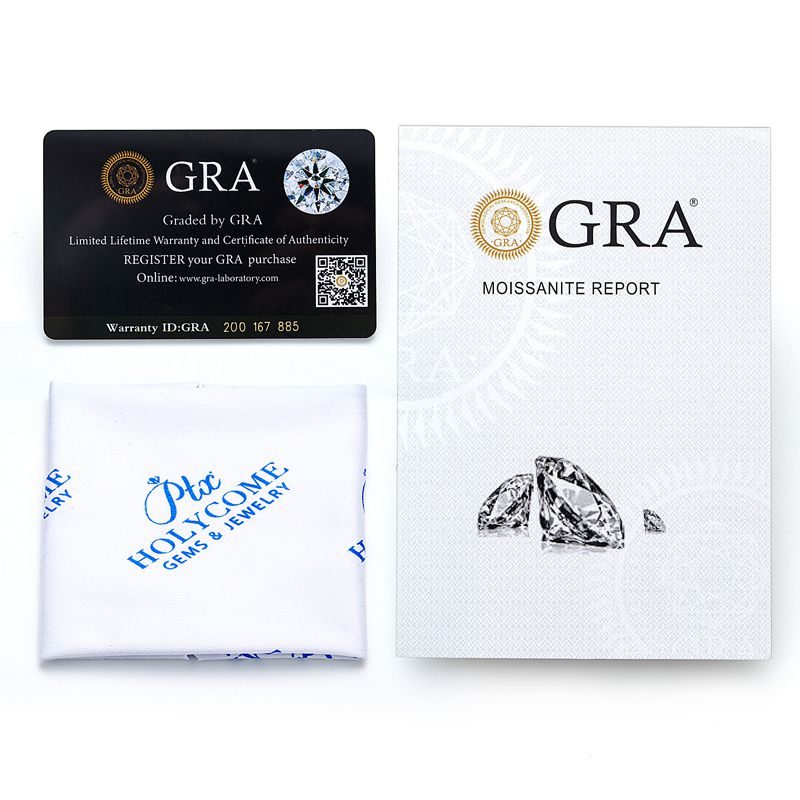
Yes. Every parcel ships with GRA or IGI documentation listing carat weight, color grade and cut.
What are the lead times?
Samples 3 to 5 days. Bulk 15 to 20 days under 500 pieces, 25 to 30 days for custom work.
Send your spec sheet — stone, cut, size, plating and quantity — and we will return a costed timeline.
Ask the workshop