Loose Stones
Loose Moissanite vs Pre-Set Rings for Custom Work: A Buyer Decision
A jewelry workshop owner in Hamburg asked us which was better for his custom engagement ring service: buy loose moissanite stones and set them himself, or order pre-set rings from a wholesale supplier. The answer depends on four numbers: cost per carat, turnaround time, grading documentation, and setting failure rate. This guide walks through each.
Cost per carat
Loose moissanite is cheaper per carat than a pre-set ring, because you are not paying for the setting labor or the finished-piece markup. A 1.5ct equivalent loose round in DEF color typically runs a fraction of the same stone pre-set in a 14k solitaire.
The difference is roughly 25% to 40% at wholesale, depending on setting complexity. You then pay your own bench for setting labor. A basic solitaire in 14k costs $40 to $80. A pavé halo costs $120 to $250. For simple solitaire work, loose stones still win. For complex halos, pre-set rings can come out within 10% of the all-in cost.
Turnaround time
A pre-set ring ships in 3 to 7 days. A loose stone ordered today, set at your bench, delivered in 10 to 21 days. For a tight wedding date, pre-set is safer.
The IGI grading lab reference explains how loose stones are documented, and the FTC Jewelry Guides require that moissanite be sold as such, not as a diamond simulant without disclosure.
Setting risk
Setting a stone is where things go wrong. A prong too tight chips the girdle. A culette not seated properly wobbles. When you buy a pre-set ring, the supplier absorbs that risk and offers a one-year warranty.
When you buy a loose stone, your workshop absorbs the risk. For workshops with an experienced setter, the risk is manageable. For workshops that outsource setting, pre-set is safer. For the broader comparison see loose moissanite buying guide, and for pre-set options see moissanite engagement rings guide.
Grading documentation
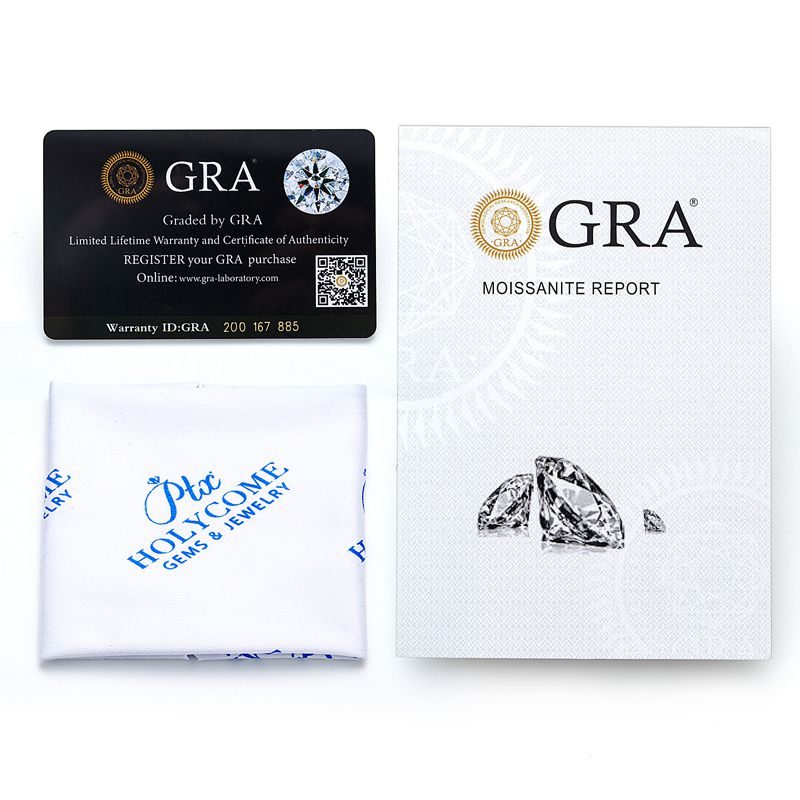
A loose stone should arrive with a grading card listing shape, carat equivalent, color grade, cut grade and measurements. Pre-set rings usually include the same card in the packaging.
Frequently asked questions
Is it cheaper to buy loose moissanite and set it myself?
For simple settings, yes, by roughly 25% to 40% at wholesale. For complex halos, pre-set rings can come out within 10% after setting labor.
How long does a pre-set ring take to ship?
3 to 7 days from a wholesale supplier. A loose stone plus in-house setting takes 10 to 21 days.
Who absorbs setting risk on a pre-set ring?
The supplier. Most wholesale pre-set rings carry a one-year stone-retention warranty. On loose stones, your workshop absorbs the risk.
What documentation should a loose moissanite arrive with?
A grading card listing shape, carat equivalent, color grade, cut grade and measurements, plus an FTC-compliant moissanite disclosure for resale.
Wholesale note: HOLYCOME supplies both loose moissanite stones (round, oval, pear, cushion, heart, emerald) and pre-set rings in solitaire, halo and pavé. All stones ship with IGI-style grading cards and private-label packaging. Mix loose stones for your custom bench with pre-set rings for fast-turnaround SKUs. Pair with stackable bands, build bridal sets, and add tennis bracelets. Request a mixed parcel to compare economics.
Which route fits your business model
If your bench has an experienced setter and your customers want custom designs, buy loose stones. If your business is e-commerce with fast turnaround, buy pre-set rings. Most successful wholesale clients mix both: 60% pre-set for the catalog and 40% loose stones for custom orders. The IGI grading lab reference documents how stones are certified.
The break-even point between loose and pre-set comes at roughly 30 custom orders per year. Below that volume, pre-set rings are more cost effective because the setting labor and setup cost is spread across fewer pieces. Above that volume, buying loose stones and setting in-house becomes cheaper. For new wholesale clients, start with pre-set and shift to loose as your custom order volume grows.
When buying loose moissanite, verify the grading report. Each stone should come with a certification card that states carat, color grade and cut grade. The FTC Jewelry Guidance requires that moissanite be disclosed as moissanite, not sold as diamond. Label every piece correctly to avoid compliance issues.
For wholesale buyers, stock loose moissanite in 6mm, 7mm and 8mm rounds as your core range. Add ovals and cushions as shaped options. Each loose stone ships with a grading card that states carat, color and cut. Pre-set rings ship ready to sell with a branded pouch and sizing kit. Mix both routes to serve custom and off-the-shelf customers.
For new wholesale clients, start with a mixed sample pack of 10 pre-set rings and 5 loose stones. This lets you test both routes without a large upfront commitment. Scale the winning route as demand clarifies.
The Gemological Institute of America’s gem encyclopedia is an authoritative, widely cited reference on moissanite and diamond quality factors.
Frequently Asked Questions
Is moissanite a viable diamond alternative for retail?
Yes for price-sensitive buyers who want brilliance and hardness. It ranks 9.25 on the Mohs scale and costs a fraction of a natural diamond of the same size, so it turns fast in bridal and fashion lines.
What is the minimum order?
MOQ starts at 50 pieces per design for stock items; custom cuts and private-label settings start at 100 to 300 pieces.
Are certificates included?
Yes. Every parcel ships with GRA or IGI documentation listing carat weight, color grade and cut.
What are the lead times?
Samples 3 to 5 days. Bulk 15 to 20 days under 500 pieces, 25 to 30 days for custom work.
Send your spec sheet — stone, cut, size, plating and quantity — and we will return a costed timeline.
Ask the workshop