Loose Stones
Choosing Loose Moissanite for a Custom Ring: Cut, Color, Cert
A custom jeweler told us he sources 80% of his moissanite loose rather than pre-set, because pre-set stones lock him into whatever the factory chose. Buying loose is the professional shortcut: you grade the stone on its papers, pick the setting separately, and you can swap heads later without buying a new center. Here is the spec sheet he hands every client.
Cut is where 90% of the money goes
For moissanite, cut matters more than color or clarity, because moissanite's higher refractive index rewards a well-proportioned cut and punishes a shallow or deep one. Target a table of 55-60% and a total depth of 60-65% on a round; outside that window the stone looks glassy or dark through the table. The framework for evaluating any faceted stone is the same one GIA 4Cs publishes for diamonds, even though the grades are assigned by moissanite labs. A poorly cut 2-carat looks smaller than a well-cut 1-carat in the same setting.
Color and clarity: where to spend, where to save
Color: D, E, F are colorless. G, H carry a faint warm tone that reads as white in white gold and platinum but shows against a sheet of white paper. For yellow-gold settings, G-H actually looks richer and costs 10-15% less. Clarity: VVS1-VVS2 is clean under a 10x loupe; VS is eye-clean at arm's length and saves 20%. Never go below SI in a solitaire; the stone has no pavé to distract from inclusions. The material itself is documented here: Wikipedia: Moissanite.
The certificate is your leverage
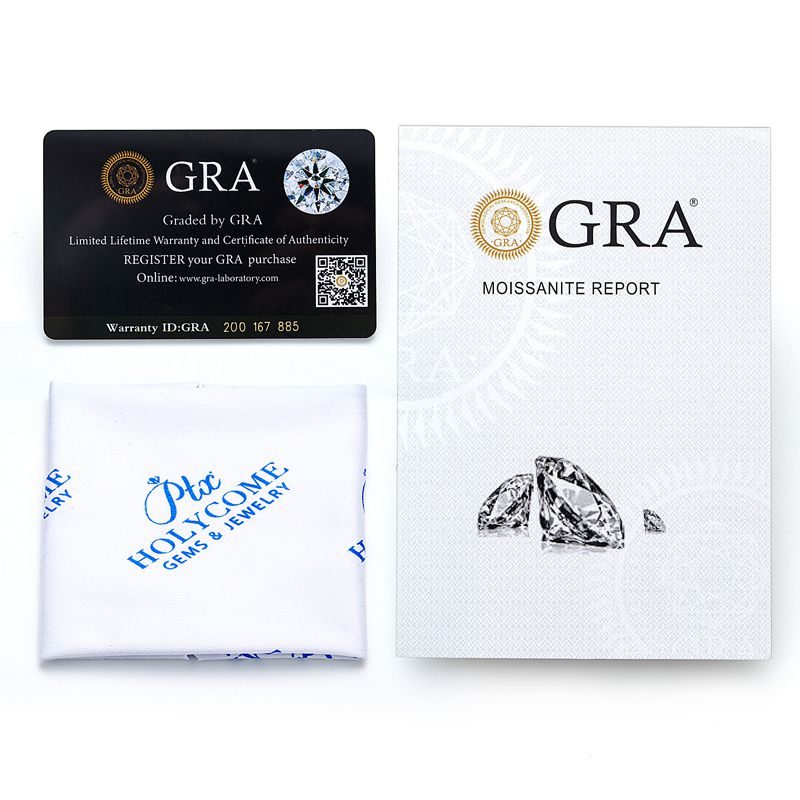
Reputable moissanite suppliers ship every loose stone with a laser-inscribed report number matching an IGI or in-house grading certificate. If a listing has no report, walk away; the stone may be a lower grade than described. Ask for: the report number (verify it online), a daylight photo, and a dark-field video showing light return. Read what brides should know about moissanite for how these specs translate on the finger, and oval vs round if you have not locked the shape.
Pairing the loose stone with a setting
When you buy loose, the setting must be sized to the stone's exact measurements, not a nominal "1ct head." Send the vendor the millimeter dimensions from the certificate, not the carat weight. A 9mm oval and a 9.1mm oval use different head sizes, and that 0.1mm is the difference between a secure stone and a wobbly one. For band pairing once the ring is built, see matching wedding bands.
Return policy: the final filter
Only buy loose moissanite from a supplier with a 14-30 day return window and a restocking fee under 10%. Grading online is imperfect, and the stone you receive may not match the photos. A generous return policy is the supplier admitting their own photos are not the whole story, and that is exactly the supplier you want to source from.
Weight vs face-up size
Moissanite weighs slightly less than diamond per carat, but carat weight is still the standard unit sold. The more useful number for ring design is the face-up diameter: a 1ct round measures about 6.5mm, a 1ct oval about 8x6mm. When you send a stone to a jeweler, send the millimeter dimensions, not just the carat. Head sizes are machined to millimeters, and a 0.2mm mismatch is the difference between a secure seat and a loose stone.
Ethics and sourcing notes
Moissanite is lab-grown silicon carbide, so it carries none of the conflict-stone concerns of mined diamond. It is not a mined stone, and FTC rules require it to be labeled "moissanite," not sold as "diamond" or "simulated diamond" without disclosure. Ask the supplier whether the stone is made in the US, China, or India; production location affects price and lead time but not the optical properties. See Wikipedia: Moissanite for the material history.
FAQ
Can I use a GIA certificate for moissanite?
GIA does not routinely grade moissanite. Expect an IGI or supplier-specific report with a laser inscription on the stone's girdle. The 4Cs framework still applies; the issuing lab differs.
What shape of loose moissanite gives the best value?
Round and cushion carry the strongest cut-and-brightness track record. Oval and pear save 10-15% but demand tighter length-to-width ratios (1.4-1.5:1) to avoid a bow-tie dark band.
Should I buy the largest carat I can afford?
No. Buy the best cut you can afford, then the largest size that fits the budget. A 1ct excellent-cut out-sparkles a 1.5ct fair-cut every time on the hand.
Can a loose moissanite be reset into another setting later?
Yes; that is the whole point of buying loose. The stone pops out of one head and into another, and the certificate travels with it. This is the most flexible way to own a bridal ring.
Bridal CTA: HOLYCOME loose moissanite ships D-F color, VVS clarity, with an IGI report, exact millimeter measurements, and a 30-day return. Pair it with any custom setting in our shop and we set it free of charge.
Frequently Asked Questions
Is moissanite a good diamond alternative for retail buyers?
Yes for price-sensitive customers who want brilliance and hardness. Moissanite ranks 9.25 on the Mohs scale, holds up to daily wear and costs a fraction of a natural diamond of the same size, so it resells fast in bridal and fashion lines.
What is the minimum order for wholesale moissanite?
MOQ starts at 50 pieces per design for stock items. Custom cuts and private-label settings usually start at 100–300 pieces depending on the mold.
Do you provide certificates with moissanite stones?
Yes. Every parcel ships with GRA or IGI documentation listing carat weight, color grade and cut. We recommend passing the certificate to your end customer for trust.
How long does sample and bulk production take?
Samples ship in 3–5 days. Bulk runs take 15–20 days under 500 pieces, and 25–30 days for custom work.
Send your spec sheet — stone, cut, size, plating and quantity — and we will return a costed timeline.
Ask the workshop