Necklaces & Pendants
How to Price Moissanite Bridal Jewelry at Retail
Most new bridal buyers mark their pieces the way they learned in a boutique: double the wholesale cost, round to the nearest dollar. That works on a $20 scarf. It loses money on a $40 moissanite solitaire, because the customer comparing it against a $3,000 diamond ring is not anchoring on your cost; she is anchoring on the diamond price she saw at the mall chain. Price moissanite the way fine jewelry prices, not the way apparel prices, and the margin opens up.
The markup tiers by category
Different categories carry different markup expectations. A customer expects a 2.5x to 3x markup on an engagement ring, because that is the fine-jewelry norm. She expects a 5x markup on small stud earrings, because small gift jewelry always carries that margin. Price each category on its own norm rather than applying one multiplier across the board.
| Category | Wholesale cost | Markup norm | Retail price | Charm price |
|---|---|---|---|---|
| Solitaire ring (6.5mm) | $40 | 3x | $120 | $129 |
| Bridal set | $70 | 3x | $210 | $219 |
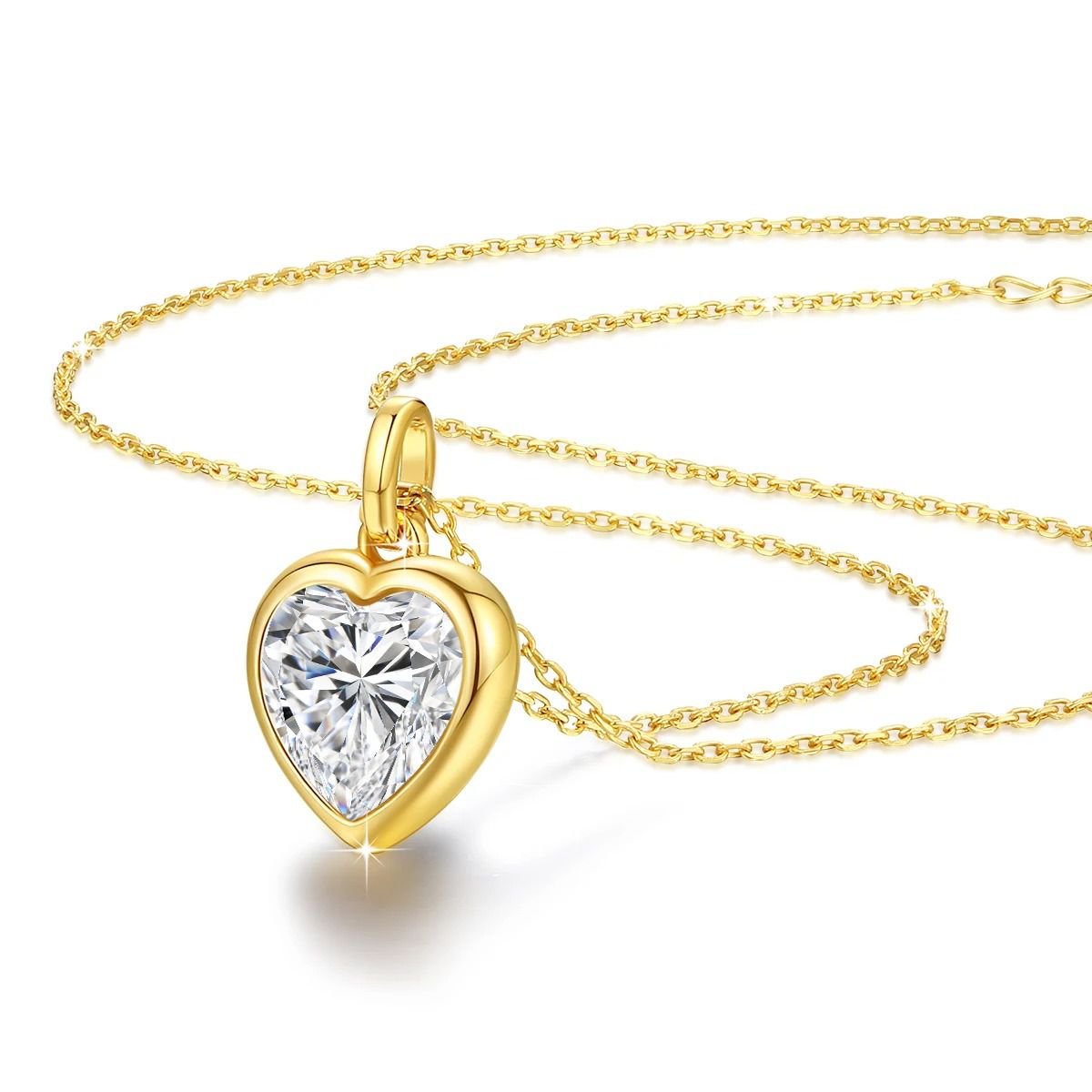
| Pendant (6.5mm) | $26 | 4x | $104 | $99 |
| Studs (5mm pair) | $13 | 5x | $65 | $69 |
| Tennis bracelet (3mm) | $48 | 3.5x | $168 | $169 |
Price anchoring against diamond
A moissanite solitaire sells when the customer sees it next to a known diamond price. Most US customers walk in knowing a one-carat diamond ring at the chain store costs $3,500 to $5,000. Your solitaire at $199 looks like a rounding error against that number, which is exactly the comparison you want. Display the moissanite ring with a small, tasteful card that says 'diamond equivalent: approximately one carat' rather than a card that argues about value. Let the customer do the math in her head; she will land on the right conclusion faster than your salesperson will.
Charmed numbers and the $199 threshold
Bridal purchases cross a psychological threshold at $200, $300 and $500. A set priced at $219 reads as 'about two hundred'; a set priced at $229 reads as 'over two hundred' even though the difference is ten dollars. Round your prices to just under the threshold - $199, $289, $469 - rather than just over. This is standard retail psychology, but it is surprising how many bridal shops ignore it and price at clean round numbers like $250 or $300, leaving ten percent of their margin on the table for no reason.
Discounting and when not to
Moissanite does not need to be discounted to sell. The customer who wants a $3,000 diamond look at $199 is already getting the deal; marking the ring down to $169 signals that the ring was overpriced to begin with, which erodes trust. The better move is to bundle: a solitaire plus a pair of matching studs at a combined price that is ten percent below buying separately. That gives the customer a deal without marking down the hero piece. Keep the solitaire price firm, and offer the bundle at the counter when she hesitates. You can review wholesale costs and compare categories inside our wholesale bridal collection before you build your price sheet.
Reading your own sell-through to tune prices
Your first price sheet is a guess. Your second price sheet, written after one selling season, is data. Track which pieces sell at the price you set and which sit on the shelf. A solitaire that sells in three weeks at $199 can probably hold $219. A pendant that sits at $99 for two months wants to be $89, or bundled with the studs. Do not be afraid to move prices based on your own shelf rather than a generic markup rule.
- Track days-on-shelf for every SKU, and not only total sales.
- Raise the price on pieces that sell in under three weeks.
- Bundle slow movers with fast movers rather than marking them down.
- Keep the hero solitaire price firm; discount the add-ons instead.
- Re-visit the price sheet after each holiday window.
The shops that treat pricing as a fixed number lose margin they did not know they had. The shops that treat it as a monthly dial keep finding ten or fifteen percent they were leaving on the table. Moissanite has margin headroom that diamond does not, because the customer is already getting a deal; the art is positioning that deal so it feels fair without giving away the profit.
Price the way fine jewelry prices, not the way apparel prices. A customer comparing your $199 solitaire to a $4,000 diamond ring at the chain store is already on your side; your job is to make the price feel deliberate rather than discounted. Charmed numbers just under the threshold, honest anchoring against diamond, and bundles instead of markdowns will hold the margin through every season. The shops that price this way treat moissanite as fine jewelry, and their customers treat it that way too. Write the first price sheet in October, then tune it against the sell-through after each holiday window.
The history and conventions of engagement rings are outlined in the Wikipedia entry on engagement rings.
Frequently Asked Questions
Is moissanite a good diamond alternative for retail buyers?
Yes for price-sensitive customers who want brilliance and hardness. Moissanite ranks 9.25 on the Mohs scale, holds up to daily wear and costs a fraction of a natural diamond of the same size, so it resells fast in bridal and fashion lines.
What is the minimum order for wholesale moissanite?
MOQ starts at 50 pieces per design for stock items. Custom cuts and private-label settings usually start at 100–300 pieces depending on the mold.
Do you provide certificates with moissanite stones?
Yes. Every parcel ships with GRA or IGI documentation listing carat weight, color grade and cut. We recommend passing the certificate to your end customer for trust.
How long does sample and bulk production take?
Samples ship in 3–5 days. Bulk runs take 15–20 days under 500 pieces, and 25–30 days for custom work.
Send your spec sheet — stone, cut, size, plating and quantity — and we will return a costed timeline.
Ask the workshop