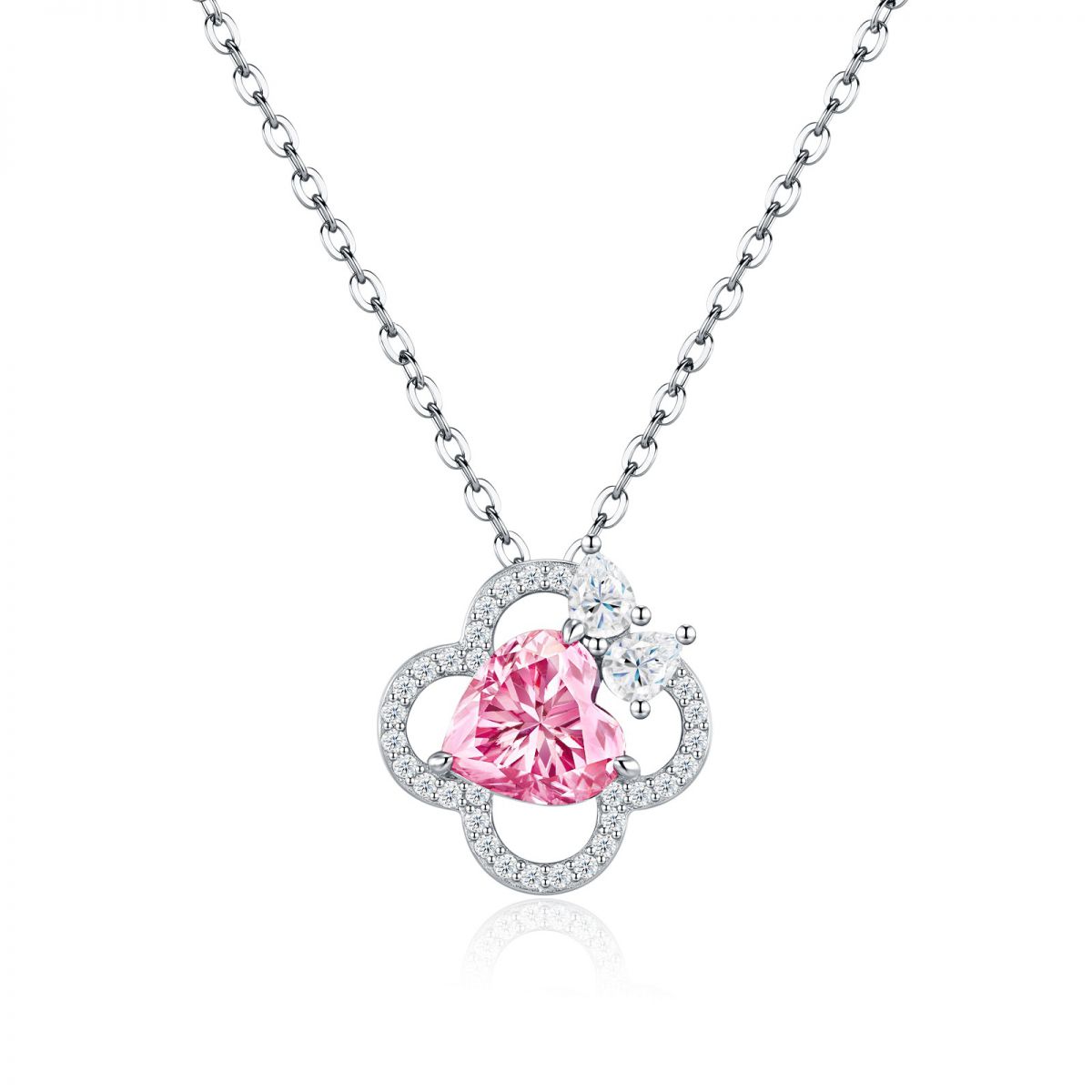
A pendant is only as wearable as its bail. The bail is the loop or fitting that connects the pendant body to the chain, and it is the component most often overlooked when retailers source pendants from a factory. A beautiful moissanite or silver pendant on a bail that is too small for the chain, too stiff to move, or too light to balance the stone will flip, catch, or tilt on the customer's neck. For independent US jewelers sourcing factory-direct from Wuzhou, understanding bail types and sizing is the fastest way to reduce returns and improve perceived quality. This guide covers the bail styles you will encounter, how to measure them, and how to match them to the chains you already sell.
What a bail does and why it matters
The bail has three jobs: it must physically attach the pendant to the chain, it must allow the pendant to rotate or hang naturally so the front face stays visible, and it must carry the weight of the stone without stretching or bending. When one of those jobs fails, the customer experience is poor even if the stone and metal finish are excellent. Because the bail is a tiny component, it is rarely visible in product photography, which is why sourcing decisions around bails are easy to miss until a return arrives.
Common bail types
Fixed (soldered) bails
A fixed bail is soldered directly to the top of the pendant body and does not move relative to it. This is the most common style for solitaire pendants, charm pendants, and nameplates. Fixed bails are strong and low-maintenance, but they require the chain to pass through an enclosed loop; if the loop is short, the pendant will sit stiffly and may not swivel. For fixed bails, inner diameter is the critical specification.
Spring and snap bails
A spring bail has a hinged, sprung opening that lets you clip the pendant onto a chain without threading the chain through. These are convenient for customers who want to move a pendant between chains, and they are widely used on charm-style and initial pendants. Spring bails should be tested for snap tension; a weak spring bail will open under light pull and the pendant will slide off the chain.
Swivel bails
A swivel bail rotates on a pivot, allowing the pendant to turn freely relative to the chain. Swivel bails are valuable for pendants that are not symmetrically weighted, because they let the center of gravity settle naturally. They are common on oval and pear-shaped moissanite pendants and on charm pendants where the front face must always remain upright.
Pinch or clip bails
A pinch bail grips the pendant body between two inward-angled prongs and is used when the pendant has no integrated loop. These are popular for pearl, cabochon, and artisan pendants. For factory-direct moissanite pieces, pinch bails are less common; they appear mainly on fashion pendants where the design detaches from the chain.
Glue-on bails
Glue-on bails are attached with jewelry epoxy to the back of flat stones or charms. They are a low-cost construction but are the least reliable under wear, especially for larger stones. For any pendant you intend to sell as fine or bridal-adjacent, avoid glue-on bails; specify a soldered or mechanically fitted bail instead.
Measuring bail inner diameter
The single most useful specification on a bail is its inner diameter, measured across the open loop. A bail that is too small will not slide over the clasp or the thicker portion of a cable chain; a bail that is oversized will look sloppy and will let the pendant flop. As a rule of thumb, the inner diameter of the bail should be at least twice the diameter of the chain it will hang from. For a 1.2 mm cable chain, look for a bail inner diameter of 3 mm or larger; for a heavier 2 mm chain, specify 4 mm or more.
When you reorder, ask the factory to state the bail inner diameter in millimeters, not in vague terms like "fits most chains." That single data point lets you match the pendant to the chains already in your display.
Chain compatibility and gauge
Beyond inner diameter, the bail must be physically compatible with the clasp you intend to sell. A lobster clasp is wider than the thin midpoint of a cable chain; if the bail cannot clear the clasp, the customer will not be able to put the pendant on without removing the clasp first. For pendants sold with a chain, confirm that the factory has actually threaded the clasp through the bail. For pendants sold as settings only, list the recommended chain gauge on your product tag.
Weight and balance considerations
A heavy stone on a thin bail is a structural problem. A 7.5 mm moissanite pendant in a four-prong setting weighs enough that a delicate, wire-thin bail will bend over time. For center stones above 6.5 mm, specify a reinforced or split bail, which distributes the load across two attachment points. The visual effect is minimal, but the structural difference is significant over years of wear.
Choosing bails for moissanite and silver pendants
For solitaire moissanite pendants, a fixed four-prong head with a reinforced round bail is the most reliable configuration. For oval, pear, or marquise moissanite, a swivel bail is worth the small premium because the asymmetric stone will otherwise twist on the chain. For nameplates and initial pendants, a fixed oblong bail is standard; ensure the bail is wide enough for an 18-inch chain and strong enough not to bend under the weight of the plate.
Cleaning and inspecting bails over time
Bails that look fine on the day of sale can loosen over months of wear, especially spring bails and swivel bails that rely on hidden hinges. Include the bail in any cleaning or inspection service you offer. Ultrasonic cleaners are generally safe for silver and moissanite pendants, but the bail should be checked afterward: close a spring bail by hand to feel for softness, rotate a swivel bail to confirm the pivot is not wobbly, and look for hairline cracks where the bail meets the pendant body. Customers who bring a pendant in for cleaning will appreciate you tightening a bail they did not know was loose, and they will not appreciate discovering the problem on their own while wearing the piece.
Conclusion
The bail is the smallest component on the pendant and the one with the biggest impact on how the piece actually wears. By asking the factory for inner diameter in millimeters, matching the bail to the chain gauge you sell, specifying reinforced bails for larger stones, and avoiding glue-on construction for fine pieces, you will cut the most common source of pendant returns. A pendant that hangs straight, rotates naturally, and clears the clasp is a pendant that gets worn rather than returned, and that is the entire point of carrying jewelry in the first place.