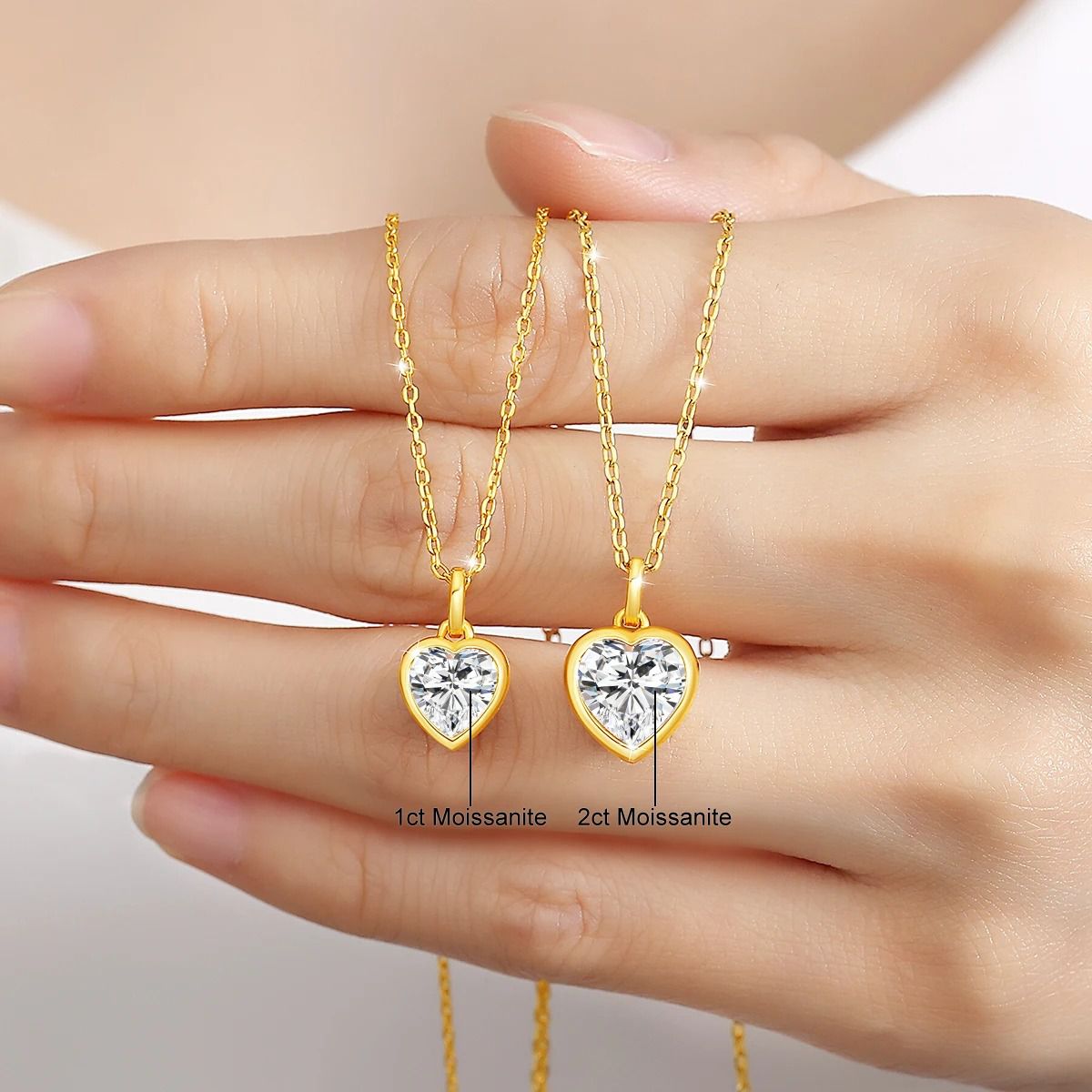
For independent US jewelers, the solitaire pendant is one of the few bridal-adjacent SKUs that moves year-round. It sits in the sweet spot between an entry-price diamond look and a gift that feels deliberate: a single center stone on a fine chain, packaged for birthdays, anniversaries, graduations, and the just-because buyer. Sourcing these pendants factory-direct from Wuzhou, China lets you compete on margin while keeping the design language your customers already trust. This guide walks through the setting styles, stone grades, metal options, and order terms that matter when you buy solitaire moissanite pendants at wholesale.
Why solitaire pendants remain a core bridal and gift SKU
A solitaire pendant does one thing extremely well: it puts the entire visual weight of the piece on a single stone. Customers who will not commit to a halo ring or a vintage-inspired band are often comfortable buying a solitaire pendant first, then returning to match earrings or a tennis necklace. That repeat-purchase behavior is what makes the pendant the ideal foot-in-the-door piece for your bridal wall.
From a merchandising standpoint, solitaire pendants are also forgiving. They photograph cleanly, they stack into gift-box displays without competing with one another, and they translate well across price points because the price is driven almost entirely by center-stone size and metal finish rather than by intricate handwork.
Setting styles retailers should stock
Four-prong versus six-prong heads
The four-prong head is the workhorse of the category. It lets more light through the crown of the stone, which flatters moissanite's known brilliance, and it uses less metal, keeping the pendant visually light on a delicate chain. Six-prong heads read as more traditional and more secure; they are often preferred for larger center stones (7.5 mm and up) and for customers who describe the piece as "heirloom-looking." Stock both, but lead with four-prong for everyday and bridal gift buyers.
Bezel and tension-style settings
A bezel-set solitaire wraps the stone in a rim of metal, protecting the girdle and making the pendant suitable for wearers who dislike catching prongs on sweaters or hair. Bezel settings also skew modern and minimalist, which pairs well with younger bridal customers. Tension-style settings, by contrast, hold the stone from opposite edges and produce a floating effect; they are a higher-margin fashion SKU but should be ordered in smaller quantities because they are a more polarizing look.
Pendant-only versus pendant-plus-earring sets
Solitaire pendants are frequently sold as part of a set with matching stud earrings. If your store already sells stud earrings, ordering a matching pendant in the same center-stone diameter lets you promote a coordinated look without carrying twice the inventory risk. Many US retailers find that pendant-plus-stud sets lift average order value by thirty to forty percent over pendant-only sales, especially during holiday gift windows.
Center stone options: DEF color moissanite and grading
When you buy moissanite pendants wholesale, the center stone is the single biggest lever on perceived quality. DEF-color, VVS-clarity graded moissanite is the standard for pieces you intend to sell as bridal or fine-jewelry-adjacent. Stones should ship with a certification card and a laser inscription on the girdle where applicable. Lower-grade moissanite, or moissanite with a noticeable gray or green body tint, belongs in fashion pricing tiers and should not be marketed against diamond alternatives.
Always ask the factory whether the stone is round brilliant, oval, or cushion, and confirm the exact millimeter diameter rather than relying on a "carat equivalent" label. Moissanite is denser than diamond, so a 6.5 mm moissanite reads larger than a diamond of the same stated carat; your customers will expect the visual size, not the weight.
Metal choices: 925 sterling silver, vermeil, and plated finishes
Most independent US jewelers sourcing from Wuzhou start with 925 sterling silver. It is nickel-compliant under US jewelry regulations, takes rhodium plating cleanly, and accepts an anti-tarnish e-coating that improves the shelf life of the piece in a display case. For a higher price tier, gold vermeil (a thick layer of gold over sterling silver) gives you a warm-metal pendant without the cost of solid gold.
Be explicit about plating thickness and rhodium content in your purchase order. A thin flash plate will dull after a few customer wears and generate returns; a properly applied rhodium finish over polished 925 silver will hold up through a year of normal wear. Nickel-free and lead-free compliance documentation should be available from the factory for every shipment.
MOQ, private labeling, and packaging for US retailers
Factory-direct solitaire pendants are typically ordered in small MOQs, often starting at ten to twenty pieces per setting style, which makes the category accessible to boutiques and online sellers rather than only to chain stores. Ask whether the supplier offers private labeling on the pouch or gift box, whether your store name can be printed on the insert card, and whether the pendant ships with a matching 16- or 18-inch chain or is sold as a setting only.
For US retailers, the most useful order configuration is a mixed carton: four-prong and bezel settings in a few center-stone diameters, each piece bagged with its own certification card, folded into a cream or navy jewelry box. That configuration lets you open the box and merchandise it immediately without additional rework.
Quality checks before you reorder
Before placing a repeat order, run a small QC pass on a sample piece: check that prongs are closed and tight against the girdle, that the bail moves freely on a chain of the gauge you intend to sell, that the rhodium finish is even, and that the pendant sits level rather than tipping forward. A pendant that flips on the chain will be returned regardless of how beautiful the stone is. Document the results and share them with the factory so corrections carry into the next batch.
How to display and price the wall
Merchandise solitaire pendants by center-stone diameter rather than by setting style. Customers shop by size first, then by look. Three tiers on one neck form — a 5 mm four-prong at the top, a 6.5 mm bezel at mid-length, and a 7.5 mm four-prong below — lets the customer compare the visual jump in a single glance. Price the tiers so that moving from 5 mm to 6.5 mm is a modest step up, and moving to 7.5 mm is a deliberate upgrade; that price ladder matches how customers actually trade up. Train your sales staff to lead with the 6.5 mm stone, because it is the size most buyers ultimately choose, and to show the 5 mm as the accessible entry point rather than the default.
Conclusion
Solitaire moissanite pendants are one of the most reliable entry points into factory-direct bridal jewelry. By mixing four-prong and bezel settings in DEF-grade stones on 925 sterling silver, specifying plating thickness and compliance documentation, and ordering in small MOQs that match your store's demand, you can build a pendant wall that photographs well, gifts easily, and creates the repeat customers that independent jewelers depend on.