Engagement Rings
Hidden Halo Engagement Rings: Wholesale Buying Guide for Retailers
The hidden halo is the quiet luxe setting that brides describe in whispers: "It has sparkle, but not the big halo look." Rather than surrounding the center stone with a visible collar of diamonds, the hidden halo tucks a ring of small stones underneath the girdle, where they peek out from the side and catch light from below. The result is a center stone that appears to glow—without the wider footprint a traditional halo adds. For retailers, it is one of the easiest settings to merchandise in 2026.
What is a hidden halo setting
In a classic halo, small accent stones form a flat, visible circle around the center stone, widening the ring's overall diameter. In a hidden halo, that same ring of pavé sits beneath the center stone's girdle, angled upward. From the top, you see only the center stone; from the side or at an angle, the accent stones flicker into view. The halo still adds carat weight and fire, but the silhouette stays clean and the center stone reads larger because the hidden halo bounces light upward into its pavilion.
Hidden halo vs classic halo
The two settings serve different brides. A classic halo maximizes perceived size—a one-carat center inside a halo can read like a two-carat stone. A hidden halo maximizes presence without the width, which suits brides with smaller fingers who love sparkle but hate a clunky look. If a client says she wants a halo but worries the ring will look "too big," the hidden halo is the answer. It also pairs more easily with a flush wedding band, since there is no protruding halo edge to bump against.
Which center stones pair best
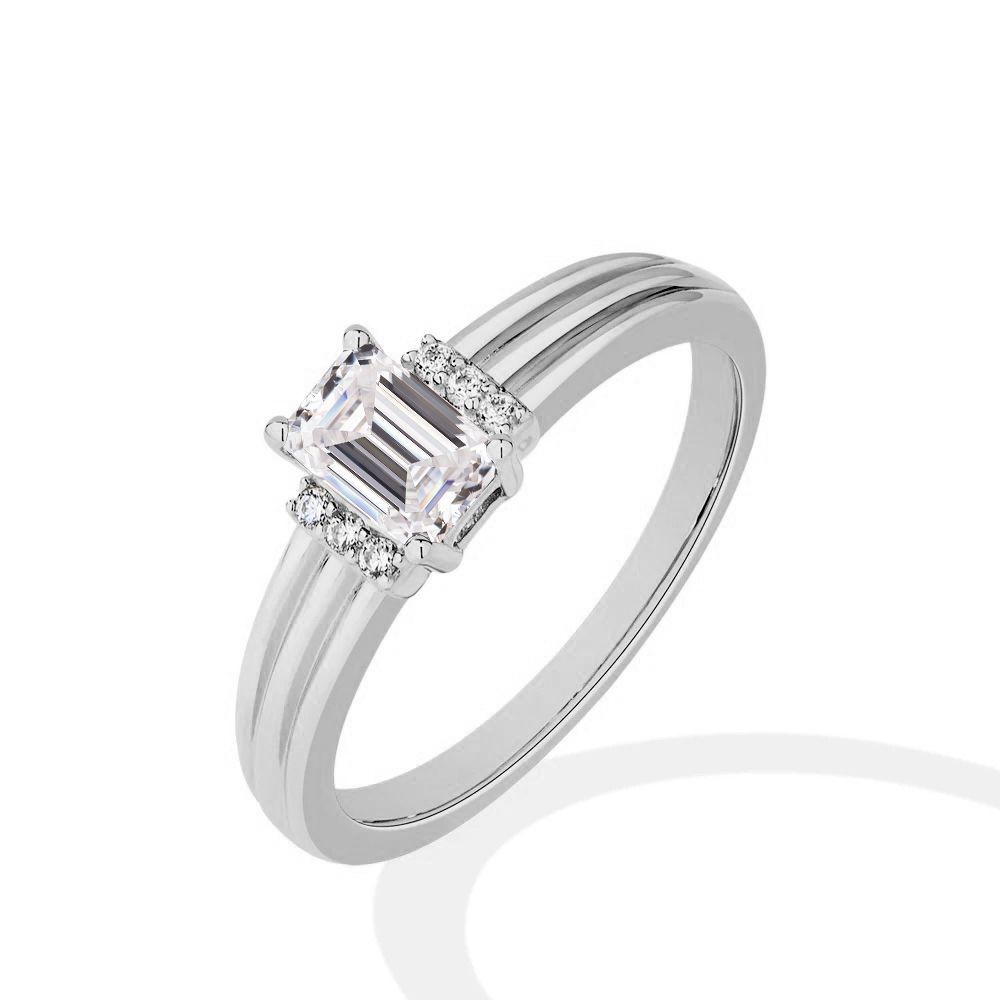
Hidden halos flatter stones that benefit from extra light return. Round and cushion-cut moissanite respond especially well, because the surrounding pavé bounces light into the stone's facets. Pear and oval centers also work, though the accent ring should follow the stone's contour rather than sit as a perfect circle. Emerald-cut centers are a mixed choice—the step-cut does not need the added fire, and the hidden halo can look busy against a clean rectangular face.
Why it is selling in 2026
The hidden halo rides two currents. Brides who grew up on Pinterest still want halo-level sparkle, but they are also leaning into quiet luxury and a clean top-down profile. The hidden halo gives them both. It also photographs beautifully, which matters enormously when a proposal ring is being documented. Retailers who carry it often report that brides compare it against a plain solitaire and choose the hidden halo once they see it on, because the glow is subtle enough to feel like the stone itself.
Sourcing and quality checklist
When buying hidden halo stock, inspect from the side angle rather than the top. Ask whether the pavé is bead-set or prong-set, and check that the accent stones are evenly sized—uneven pavé is the fastest way a hidden halo looks cheap. Confirm the gallery is reinforced; because the accent ring sits low, it can catch on surfaces if the head is raised too high. As with any setting, verify that prongs on the center stone are sturdy and that the head construction matches your other moissanite settings for consistency.
Pricing, margin, and display
Hidden halos sit between a solitaire and a full halo in cost, which makes them a strong margin item. Price them above a comparable solitaire but below a classic halo. The display move is to show the ring from two angles: top-down on a flat surface, then tilted on a finger riser so the hidden pavé is visible. Most of the sale happens at that tilt moment. Pair the presentation with a clear tiered price ladder so brides can trade up in center size rather than abandoning the setting entirely.
Customer questions to anticipate
Brides almost always ask three things. First, whether the hidden halo gets dirty—it does, because the pavé sits in a crevice, but a soft brush and warm soapy water keep it bright; mention that the ring will need slightly more frequent cleaning than a plain solitaire. Second, whether it still looks like a halo from straight on—show them: from above, the center stone alone is visible, which is exactly the quiet look they wanted. Third, whether a wedding band will sit flush—it usually does, because there is no protruding halo edge, which is one of the strongest selling points to demonstrate.
Because the effect is subtle, photographs help. Keep a few side-angle shots on hand that show the hidden pavé catching light, since a top-down catalog photo will not communicate what makes the setting special. Brides who see it in person, tilted under the case light, are the ones who buy it.
Because the hidden halo is still new to many clients, verbal framing matters. Call it "a solitaire with a secret" rather than "a halo," and watch how quickly the right bride connects with it. It is one of the few settings that reads more expensive than it is—exactly the kind of inventory move that keeps a bridal floor differentiated.
Independent background on moissanite — how its hardness and refractive index compare with diamond — is documented in the Wikipedia article on moissanite.
Frequently Asked Questions
What ring sizes can you supply in bulk?
US sizes 5–12 including half sizes. Send a size breakdown with your order and we cast to that curve; comfort-fit inner bands reduce resize requests.
Can I order a mixed size run instead of one size?
Yes. Mixed runs are standard for wholesale: specify quantity per size and we pack and label by size at no extra labor cost.
What is the MOQ for custom ring designs?
50 pieces per design for existing molds; 100–300 pieces when a new mold or CAD model is required.
How should I price rings for retail margin?
Most partners use a 3–4x markup on FOB cost for sterling and 2.5–3x for moissanite solos, which keeps landed cost under 30% of retail.
Send your spec sheet — stone, cut, size, plating and quantity — and we will return a costed timeline.
Ask the workshop