Moissanite engagement rings are no longer a niche alternative. Across the US, bridal customers walk in asking for moissanite by name, and independent retailers who stock it are winning customers who would otherwise buy online from a big box. The wholesale side of the business, though, has its own logic: shapes, settings, certificates and minimum orders that differ from buying finished diamond jewellery. This guide walks through what a US retailer should know before placing a first bulk order with a moissanite factory.
If you have not seen our range yet, the wholesale engagement rings collection is where these orders start, and the wholesale info page covers MOQ, tiered pricing and shipping.
Why moissanite is winning the bridal counter
Three things drive the demand. First, price: a 2-carat lookalike centre stone costs a fraction of a 2-carat diamond, which lets customers get the size they actually want. Second, ethics: moissanite is lab-grown with no mining footprint, which resonates with millennial and Gen Z buyers. Third, durability: moissanite scores 9.25 on the Mohs scale, so it survives daily wear nearly as well as diamond. Retailers who explain these three points on the floor convert browsers into buyers fast.
Shapes to stock first
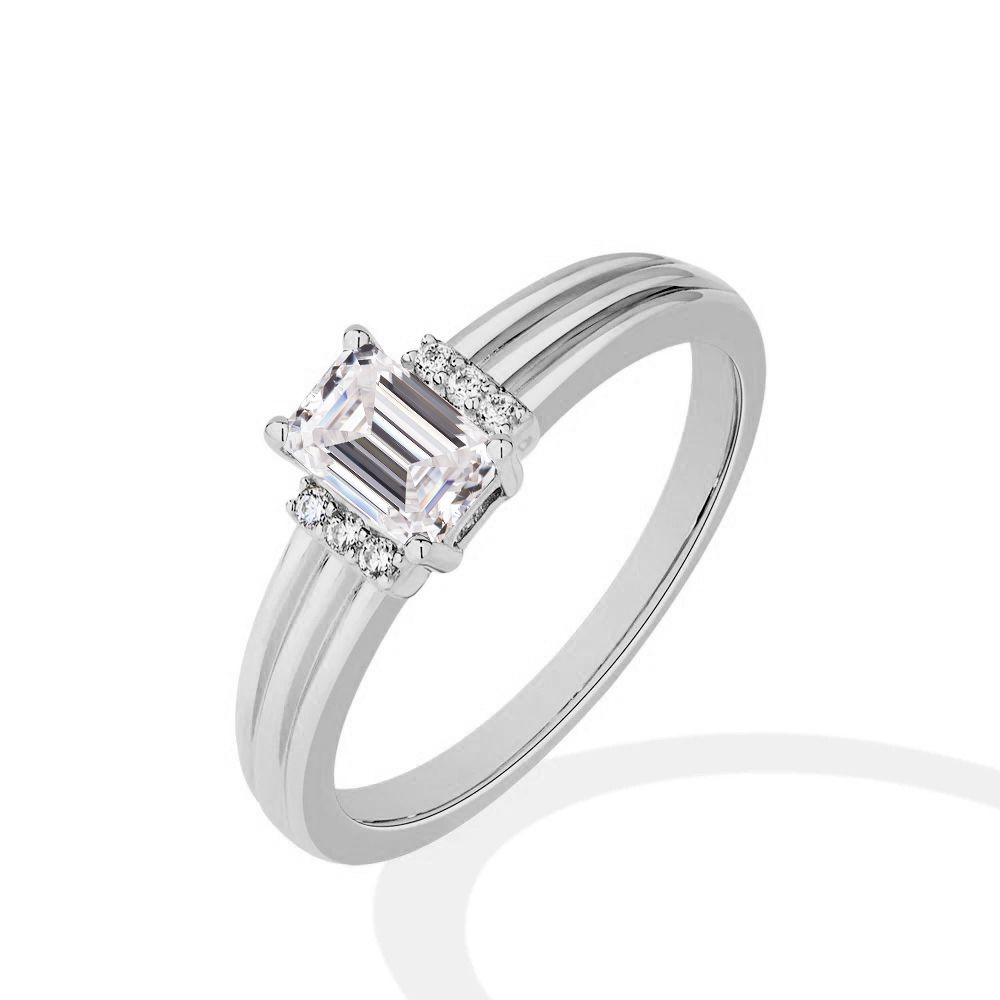
Not every shape sells equally. Start with the round brilliant — it is the default and moves fastest. Oval and pear are the rising shapes, especially for customers who want a larger look on a smaller budget. Cushion and radiant are for the more discerning buyer. Avoid over-ordering marquise or heart shapes on a first purchase; they sell but slower. The engagement rings range shows the full shape menu, and our 1ct round solitaire ring is the standard first SKU to reorder.
Settings: solitaire, halo and three-stone
Solitaire settings are the backbone of the range — timeless, easy to size, and pair with any wedding band. Halo settings sell on visual size: a 1ct centre with a halo reads as a 1.5ct stone, which customers love. Three-stone settings carry a past-present-future story that sells well around proposal season. A first order should be roughly half solitaires, a third halos, and a sixth three-stone or vintage styles. The marquise round halo and the twisted pear ring are examples of halo and vintage styles retailers ask for.
The GRA certificate is non-negotiable
Every moissanite engagement ring you stock should ship with a GRA certificate that matches the stone. The certificate is what turns a £50 fashion ring into a bridal purchase, and it is what your customer will show their partner. Without it, the ring is just CZ to the end buyer. Ask the supplier to confirm the certificate number matches the stone before dispatch. Our about us page explains how our own factory verifies certificates on every piece.
MOQ, tiers and reorder rhythm
Most wholesale moissanite suppliers, including us, work on a small MOQ — typically 2 pieces per style — with tiered pricing that drops as quantity rises. For a first order, buy 2 pieces of your 8 to 10 best shapes, test them on the counter for 60 days, then reorder the winners. Over-ordering slow shapes ties up cash; under-ordering fast shapes means a lost sale. Our wholesale info page lists the exact tier pricing and shipping terms.
Pricing for retail margin
Wholesale moissanite rings carry strong retail margins because the perceived value is high while the cost is low. A ring bought at wholesale for a modest figure retails at a healthy multiple, especially when presented as a GRA-certified bridal piece rather than fashion jewellery. Train your staff to talk about the certificate, the carat-equivalent size, and the warranty — that is what justifies the retail price, not the stone itself.
Common mistakes new buyers make
- Ordering too many shapes at once instead of testing 8 to 10 first.
- Forgetting to check certificates match the stones.
- Ignoring ring sizes — stock the middle sizes (US 5 to 7) first.
- Treating moissanite as cheap fashion jewellery rather than a bridal category.
- Not asking about reorder lead times before the busy proposal season.
The bottom line
Stock round solitaires first, add halos and three-stone styles, always demand GRA certificates, and reorder the shapes that actually move. Moissanite is now a bridal category, not a trend, and retailers who merchandise it properly win customers who would otherwise shop online. When you are ready to order, request a wholesale quote and we will send tiered pricing for the shapes that suit your customer base.
How we ship and what the MOQ actually means
We work with a small minimum order so a new retailer can test the range without a big commitment. Most styles start at 2 pieces, and the unit price drops as you move into the 5-19 and 20+ tiers. This is designed so a first order of 15 to 20 rings fills a tray without tying up cash, and you can reorder the winners within weeks. DHL and FedEx shipping to the USA takes three to seven days, and every order ships tracked and insured. If you are comparing suppliers, the wholesale info page lays out the exact tiers, payment terms and shipping options so there are no surprises on the invoice.
Frequently asked questions
Do the rings come with certificates? Yes, every GRA moissanite ring ships with its matching certificate, which is what lets you sell it as a certified bridal piece rather than fashion jewellery.
Can I order one of each shape to test? The MOQ is 2 pieces per style, so you can build a broad first test order across 8 to 10 shapes without over-committing.
What ring sizes should I stock? Start with US 5 to 7, where most demand sits, and add a couple of edge sizes once you see what your customers buy.
Do you ship sample orders? Yes, small sample orders are welcome so you can see the quality before committing to a full tray. Request a quote to start.
What your first order should look like
For a first wholesale order, we suggest building a tray of about 18 to 22 rings rather than buying deep in one style. Pick eight to ten shapes — round solitaire, oval solitaire, pear, cushion, radiant, hidden halo, three-stone and pavé — and take two pieces of each in a middle ring size. This gives your display variety, means you are not caught out if a customer asks for a shape you did not stock, and lets you read demand with real data instead of a guess. Once six to eight weeks pass, look at which shapes sold through and reorder those. The losers you stop buying. This small-batch approach keeps your cash working and your case fresh.
Do not forget to order the matching bands at the same time. A customer who buys a solitaire on Saturday will want a wedding band within the year, and if you have the matching one on hand you close the upsell. Keep ring sizes US 5, 6 and 7 as your core, with one size 4.5 and one size 7.5 for edge customers. Every ring ships with a GRA certificate and a gift box, so you are ready to sell from day one. See the full range on the engagement rings page and the quote page for pricing tiers.