Engagement Rings
Tension Setting Engagement Rings: How They Work and Who They Suit
Few settings look as futuristic as a tension ring. The center stone appears to float in a gap between the two ends of the band, held by nothing the eye can immediately see. There are no prongs curling over the crown, no bezel rim wrapping the girdle. The gem seems to hover in midair. That illusion is exactly why the style divides buyers: some find it breathtakingly modern, others find it visually uneasy.
How a tension setting actually holds the stone
The band is cut at the top and engineered so the two ends exert inward pressure on the stone’s girdle. Tiny grooves are milled into each end to cradle the edges of the gem, and the band stores enough spring tension to keep those ends squeezing shut. The stone is compressed in place rather than clamped by a separate head. In practice, most “tension” rings sold today are semi-tension: they use the floating visual but add hidden support underneath, because a true all-tension setting demands precision machining that few small shops can repair on site.
The design relies on the band metal acting like a spring. This is why platinum and certain sturdy white gold alloys are preferred over soft, thin shanks. Buyers comparing platinum versus white gold will often find tension pieces offered in the former for exactly this structural reason.
Which stones work in tension
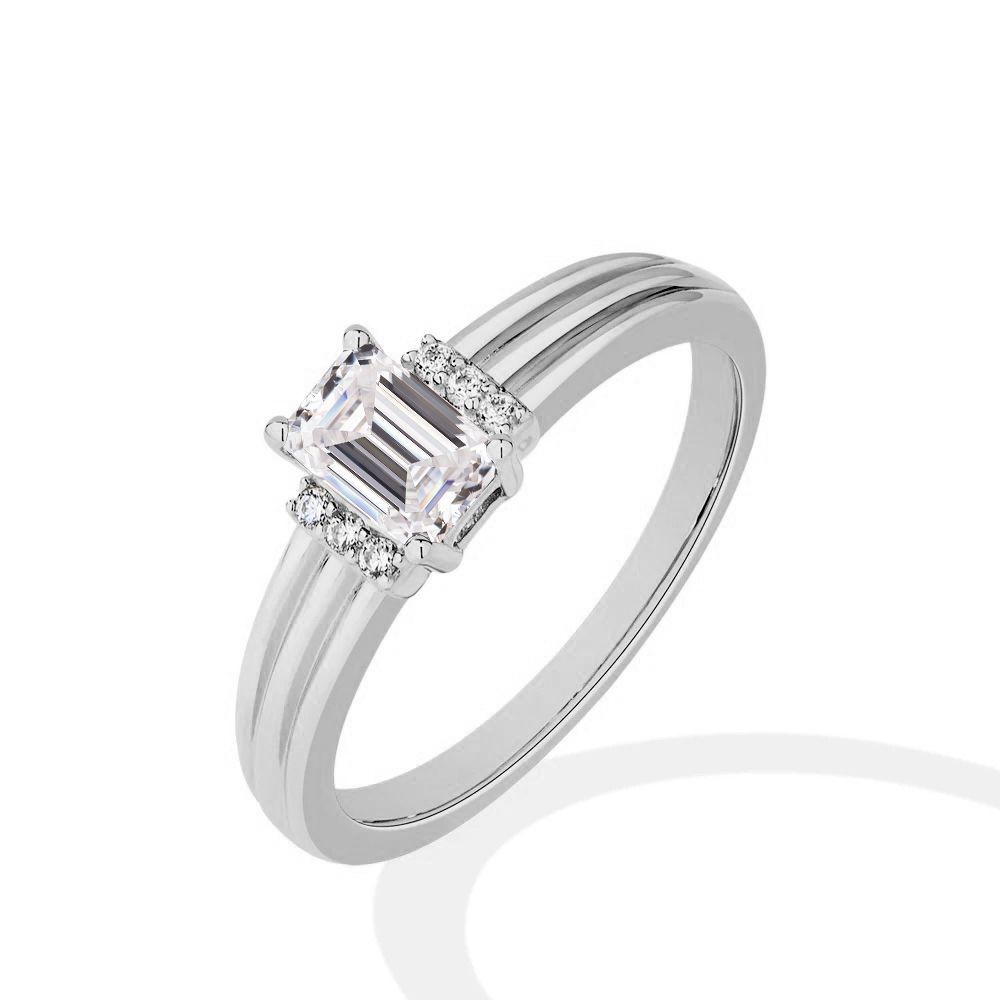
Tension settings press directly on the girdle, so the stone needs a durable edge that can tolerate lateral force. Moissanite handles this well; its hardness and toughness make it more forgiving than softer gems like opal or pearl. Among prong, bezel, and pavé settings, tension is the odd one out, and it tends to suit stones with clean, defined girdles rather than heavily faceted or chipped edges. Princess, emerald, and cushion cuts commonly appear in tension designs because their crisp edges seat neatly into the milled grooves. Round stones can work too, but the setting hardware is more specialized.
The durability conversation to have up front
A floating stone sounds delicate, and buyers assume it will fall out. The honest answer is that a well-made tension ring is secure, but it is not invincible. A hard impact to the band can release the stored tension and shift the stone. For this reason, a tension setting is a poor match for someone who rocks climbs, lifts weights with bare hands, or does heavy manual work. It suits a buyer with a desk or retail lifestyle who wants a piece that reads as sculptural art. Expect to recommend the setting alongside regular check-ups, because the grip should be inspected annually just as prongs should be.
Sizing and repair limits
Here is the practical catch that surprises first-time buyers. Resizing a tension ring means re-cutting and re-tuning a precision spring, which most local jewelers cannot do and which can void a warranty. A customer who is unsure of her finger size should be sized carefully before the ring is made, and anyone between sizes should lean toward a snug fit rather than a loose one. Repair work on a tension head typically goes back to the maker, so lead times matter. This is a setting to sell confidently, but only after the buyer understands the aftercare commitment.
Who should buy it
Tension engagement rings attract buyers who find solitaire and halo rings too conventional. They want something with an architectural, almost sculptural quality, and they are usually comfortable with a slightly pricier, made-to-order piece. The style pairs beautifully with a plain, polished band on the opposite hand and reads especially modern against a matte or brushed finish. For a shopper who wants conversation without flash, and who treats her jewelry gently, a tension-set moissanite ring is a distinctive choice that still feels quietly bridal.
Styling a tension ring day to day
Because the setting is the design, a tension ring needs very little extra around it. Most owners choose a plain, low-profile wedding band rather than a pavé one, so the hand does not become visually noisy. The floating stone already carries the visual weight; adding a crowded band beside it competes rather than complements. A slim polished band, worn flush or slightly offset, lets the tension ring remain the focal point it was designed to be.
Cleaning is straightforward, but the method matters. Soaking the ring in warm, soapy water and brushing gently around the milled girdle seats keeps the stone bright without disturbing the tension. Avoid ultrasonic cleaners unless the maker explicitly approves them, because the vibration can over time affect the tuned grip. A soft cloth after washing hands is enough for day-to-day upkeep, and the annual check-up is really about confirming the stone has not shifted under its own pressure. Treated that way, a tension-set moissanite ring stays a conversation piece for years.
For third-party reference, the Wikipedia article on moissanite details moissanite’s discovery, optical properties and use in jewelry.
Frequently Asked Questions
What ring sizes can you supply in bulk?
US sizes 5–12 including half sizes. Send a size breakdown with your order and we cast to that curve; comfort-fit inner bands reduce resize requests.
Can I order a mixed size run instead of one size?
Yes. Mixed runs are standard for wholesale: specify quantity per size and we pack and label by size at no extra labor cost.
What is the MOQ for custom ring designs?
50 pieces per design for existing molds; 100–300 pieces when a new mold or CAD model is required.
How should I price rings for retail margin?
Most partners use a 3–4x markup on FOB cost for sterling and 2.5–3x for moissanite solos, which keeps landed cost under 30% of retail.
Send your spec sheet — stone, cut, size, plating and quantity — and we will return a costed timeline.
Ask the workshop