Necklaces & Pendants
4-Prong vs 6-Prong Solitaire Pendant Settings
A solitaire pendant is the simplest piece in a bridal collection: one stone, one bail, one chain. Yet even that simplicity hides a choice that quietly changes the whole look—how many prongs hold the stone. The classic debate is four prongs against six, and it is worth understanding before you stock pendants or buy one as a gift for a bride.
What the prongs actually do
Prongs are the little metal claws that grip the stone around its girdle. A well-made setting tapers each prong to a neat tip and curves it over the crown so the stone cannot slip out. The number of prongs affects two things at once: how much of the stone you can see, and how safely it is held.
This is the same tradeoff jewelers debate on rings, and our guide to solitaire moissanite pendant settings covers the broader setting choices. The prong-count question is the fine-grained version of that decision.
Four prongs: maximum stone visibility
Four prongs, placed at the corners of the stone, leave the largest possible windows of open light. On a round or cushion-cut moissanite, four prongs make the stone look bigger and brighter, because more of its surface is unobstructed. It is the choice for a bride who wants the pendant to read as “stone first.”
The downside is security. With fewer claws, each prong carries more of the holding force, and a single bent prong leaves the stone vulnerable. A four-prong pendant should be checked at a jeweler annually, especially if it is worn daily.
Six prongs: security and a rounder look
Six prongs distribute the holding force evenly around the stone's edge. The stone sits more securely, and the additional claws can be filed into rounded tips that catch less on clothing and hair. On a round stone, six prongs also create a softer, more circular silhouette, which many people find more flattering on a delicate chain.
The cost is a little visibility. Six prongs cover more of the stone's edge, so a small pendant looks slightly more “set” and slightly less “floating.” On stones under half a carat equivalent, that difference is barely noticeable; on larger pendants, it shows.
Shape matters too
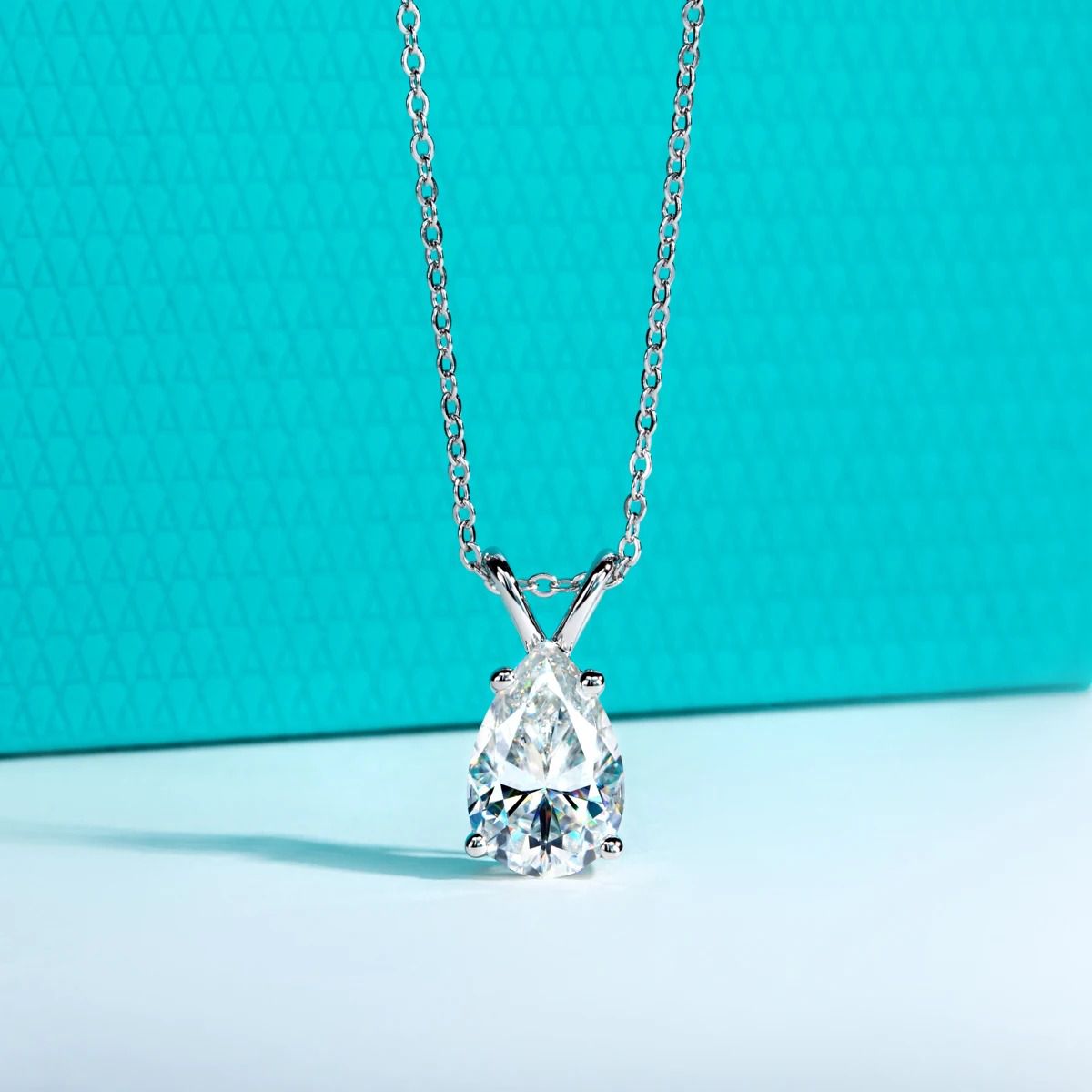
Prong count interacts with stone shape. Round stones take either four or six well. Pear, marquise, and trillion shapes often use a weighted prong at the point, since the tip is the most exposed and most likely to snag. Emerald and oval stones sit well in four prongs that frame the corners. When you match a moissanite pendant to a carat-to-mm size, ask the supplier which prong layout the setting is built for—it is not always interchangeable across shapes.
Which to stock or choose
For retailers, carrying both four- and six-prong versions of the same pendant template is a smart move. The four-prong appeals to brides chasing maximum sparkle; the six-prong appeals to anyone who plans to wear the pendant every day, including to work and travel. A six-prong pendant also makes a safer first “real jewelry” gift for a younger bride who may not yet be in the habit of checking her settings.
For a single purchase, choose four prongs if the pendant is a special-occasion piece meant to dazzle, and six if it will live on the neck daily. Either way, a secure bail and a quality chain matter just as much as the prongs holding the stone.
For retailers, displaying the same stone on a four-prong and a six-prong setting next to each other is a quiet but effective sales tool. Shoppers rarely know which they prefer until they see both, and the comparison justifies the price difference between the two templates. It also reduces returns, because the buyer chooses the setting deliberately rather than guessing from a product photo.
For a bridal shop, keeping both prong counts in stock on the same pendant template adds almost no extra cost, since the difference is a few extra claws rather than a new mold. That small flexibility is what lets a salesperson say yes to both the sparkle-first bride and the safety-first bride in the same afternoon.
Pairing the pendant with the right chain
A solitaire pendant lives or dies by its chain. A two-tenths-of-a-millimeter cable chain keeps the focus on the stone, while a slightly heavier rolo chain reads more casual and works on a broader neckline. The bail itself should move freely so the pendant flips to face forward on its own; a stiff bail leaves the stone turned sideways, which wastes the whole point of the setting. For brides who plan to layer the pendant with a shorter chain, a slightly larger bail and a longer chain length make the stack sit cleanly without tangling. These small choices are what turn a nice pendant into one a woman reaches for every morning.
For third-party reference, the Wikipedia article on moissanite details moissanite’s discovery, optical properties and use in jewelry.
Frequently Asked Questions
Which chain lengths should I stock first?
16 to 18 inch covers most necklines and gift purchases. Add 20 inch for layering sets and 24 inch for pendant lines.
Are your chains nickel-free and hypoallergenic?
Yes. Sterling silver is 92.5% silver; stainless lines use 316L. Both are nickel-safe for reactive customers when plated correctly.
Can necklaces be personalized?
Laser engraving on pendants and clasps is available from 50 pieces, with 3–5 day turnaround on the engraving step.
What is the bulk lead time?
15–20 days under 500 pieces; 25–30 days for custom pendants or new molds.
Send your spec sheet — stone, cut, size, plating and quantity — and we will return a costed timeline.
Ask the workshop