Engagement Rings
Radiant Cut Moissanite: The Sparkle Pattern Brides Ask For
A buyer in Denver told us her brides were asking for something that looks like a cushion but flashes like a round. She did not know what to call it. The answer was radiant cut. Once she put a 7x7mm radiant moissanite in the case, it sold in two weeks, and the bride posted a photo where the stone threw light across the room. Radiant is the cut that sits between cushion and emerald in the bridal lineup, and it is under-stocked in most boutiques. If your case has rounds, cushions and ovals but no radiants, you are missing a specific request.
What a radiant cut actually is
A radiant is a square or rectangular stone with clipped corners and a full faceting pattern borrowed from the round brilliant. It has about 70 facets, which is more than a cushion and more than an emerald, so it flashes bright white light in short bursts. The outline is square or rectangle, so it reads modern and geometric, not soft. This is the combination brides mean when they say they want sparkle but not a round. The length-to-width ratio for a square radiant is 1.0 to 1.05:1; for a rectangular radiant it is 1.2 to 1.3:1. Most boutiques start with the square 6x6 and 7x7mm because the rectangular reads too long for some hands. For comparison, our note on cushion vs emerald shows how the three adjacent cuts differ on the hand, and our cushion softness page explains why cushion brides sometimes switch to radiant for more flash.
Why radiant sparkle reads differently
The facet arrangement in a radiant puts triangular facets across the crown, which breaks light into small sharp flashes rather than the broad soft reflections a cushion gives. In moissanite, which has a higher refractive index than diamond (2.65 versus 2.42, per moissanite reference), those flashes are brighter and more colorful. That is why a radiant moissanite looks especially lively under indoor light, where a diamond can look dull. When you photograph a radiant for the website, shoot it under soft directional light so the triangular facets show up; under flat overhead light the stone looks like a plain square. For general cut education you can point shoppers to GIA 4Cs education on how facet arrangement affects light return.
Settings that suit a radiant
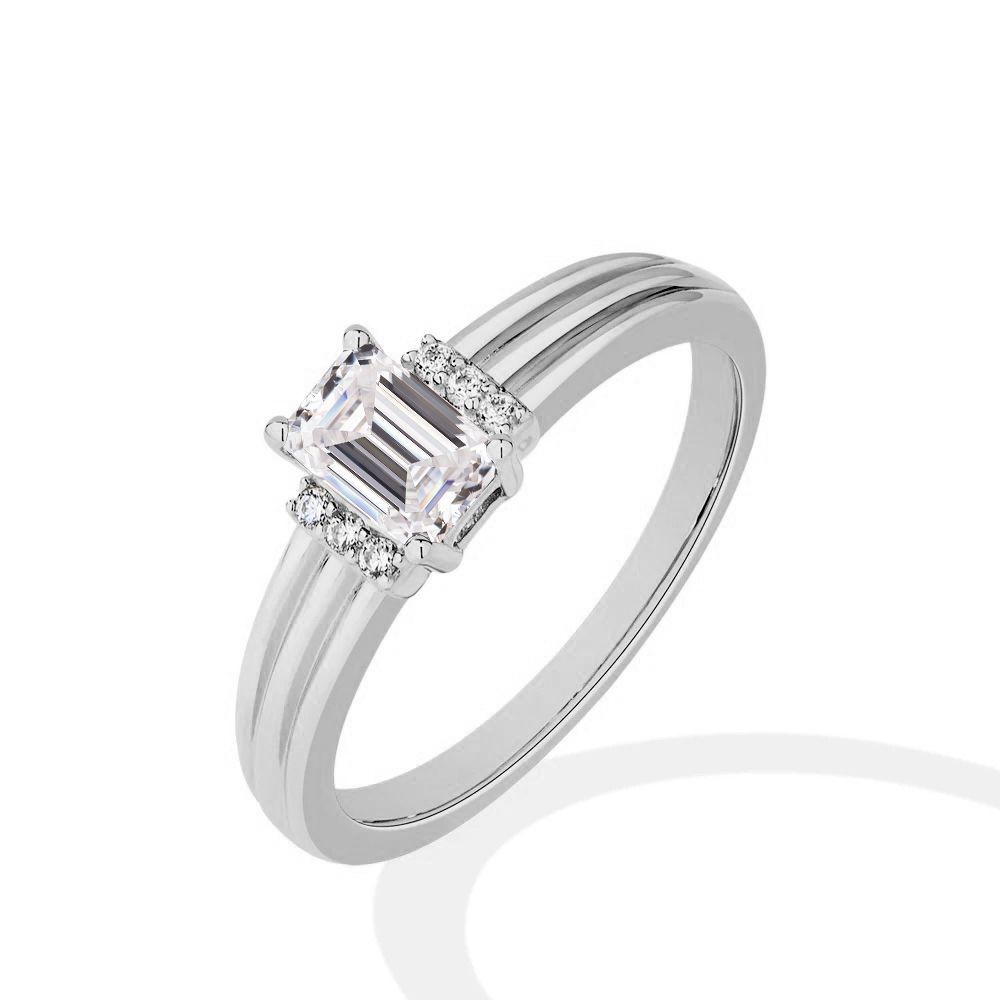
A radiant takes well to a four-prong solitaire because the clipped corners sit naturally under the prongs. A bezel also works because the straight edges of the square fit a rim cleanly. What does not suit a radiant is a heavy halo of small round stones, because the halo softens the geometric outline that makes the radiant distinctive. If you want to add small stones, use a thin pavé band rather than a halo head. Pair the radiant with a 2.0 to 2.3mm band so the square face stays the hero. For active brides, our note on active settings explains why a low four-prong head is safer than a tall pavé halo on a stone that swings on the hand.
What to stock and how to price it
Start with two sizes: 6x6mm (about 1.5ct equivalent) and 7x7mm (about 2.5ct equivalent), both in near-colorless EF. The 6x6 is the everyday size, the 7x7 is the engagement size brides photograph. Both ship with a four-prong 14k head in yellow, white or rose gold. If a bride wants a rectangular, order it to spec at 7x5.5mm; we cut it on request. All our moissanite is graded eye-clean VVS and ships with a certificate from IGI laboratory grading or NGTC. For US resellers the stone disclosure follows FTC Jewelry Guides and 16 CFR Part 23 labeling so you can sell it as moissanite without confusion with diamond or lab-grown.
Is a radiant cut more or less sparkly than a round?
It flashes in shorter bursts and reads more geometric. Round has broader light return; radiant has sharper, smaller flashes.
Does a radiant look like a cushion?
The outline is similar, but a cushion has softer corners and broader facets. A radiant has clipped corners and more facets, so it is brighter.
What size radiant should I stock first?
The 7x7mm square. It is the engagement size and the one brides photograph and share.
Can a radiant be set in a bezel?
Yes. The straight edges fit a bezel cleanly and the clipped corners disappear under the rim.
Does radiant moissanite show inclusions?
Our stock is eye-clean VVS, so no. Inclusions are not visible to the naked eye in the 6x6 and 7x7 sizes we ship.
When a bride asks how a radiant compares to a princess cut, the easiest way to explain it is that the princess has sharp 90-degree corners and a step-facet pattern that reads more linear, while the radiant has clipped corners and a mixed facet pattern that flashes brighter. The radiant also tends to show less color in the corners than a princess, because the clipped corner removes the area where inclusions or tint tend to sit. For brides who want the geometric look of a princess but the sparkle of a round, the radiant is the middle choice. We stock it in both square and rectangle on request.
Order a radiant cut moissanite sample in 6x6 and 7x7mm near-colorless EF, four-prong 14k head, with an IGI or NGTC certificate. MOQ 5 pieces per size, ready for boutiques that want to offer a cut their case is missing.
Frequently Asked Questions
Is moissanite a good diamond alternative for retail buyers?
Yes for price-sensitive customers who want brilliance and hardness. Moissanite ranks 9.25 on the Mohs scale, holds up to daily wear and costs a fraction of a natural diamond of the same size, so it resells fast in bridal and fashion lines.
What is the minimum order for wholesale moissanite?
MOQ starts at 50 pieces per design for stock items. Custom cuts and private-label settings usually start at 100–300 pieces depending on the mold.
Do you provide certificates with moissanite stones?
Yes. Every parcel ships with GRA or IGI documentation listing carat weight, color grade and cut. We recommend passing the certificate to your end customer for trust.
How long does sample and bulk production take?
Samples ship in 3–5 days. Bulk runs take 15–20 days under 500 pieces, and 25–30 days for custom work.
Send your spec sheet — stone, cut, size, plating and quantity — and we will return a costed timeline.
Ask the workshop