Necklaces & Pendants
The Lariat Y-Necklace: A Bride's Secret Weapon for the Wedding Day
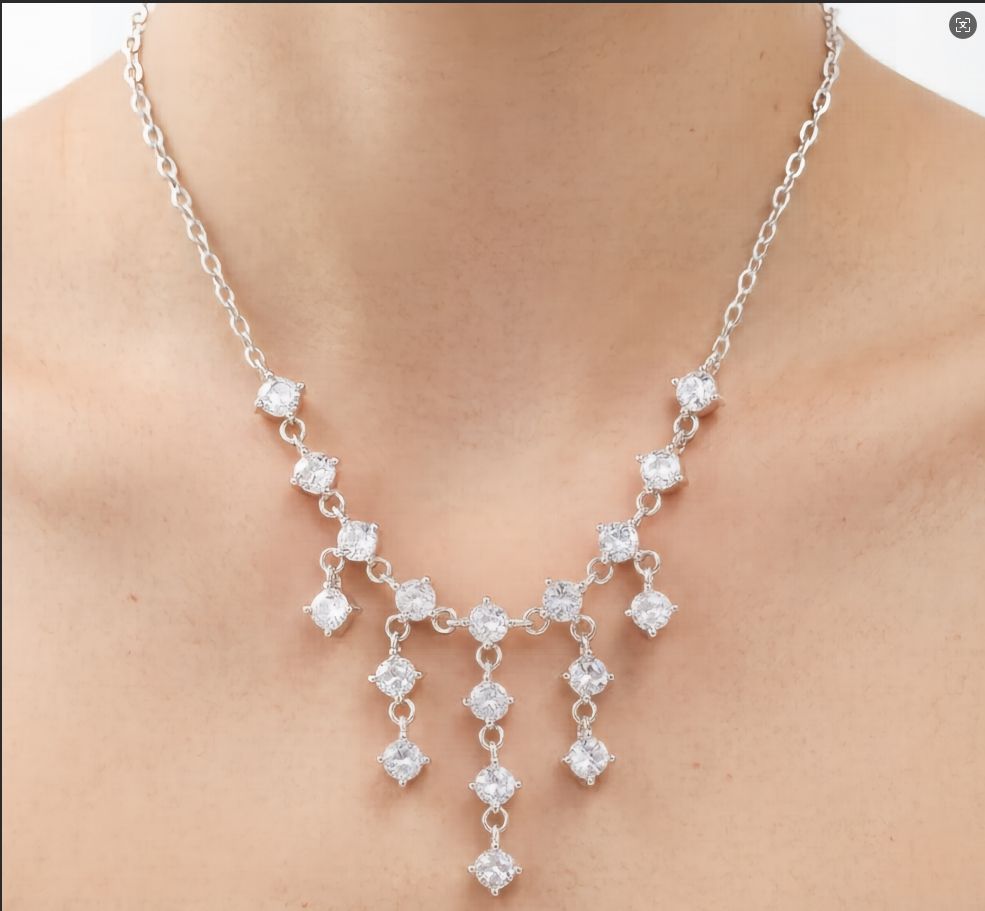
When brides want a necklace that does more than sit there, they reach for a lariat. The lariat, or Y-necklace, is a single chain that drops in a soft V down the chest, ending in a small stone, tassel, or bare taper. It has been a red-carpet staple for years, and it has finally become one of the most requested bridal necklaces for modern weddings.
What makes it bridal-friendly
A lariat solves a problem that plain pendants cannot. A standard pendant hangs in one fixed spot, which can feel static against a gown. A lariat, by contrast, draws the eye in a long vertical line, lengthening the neck and framing the collarbones. On a strapless or sweetheart gown, that line creates shape where the dress itself is simple. On a V-neck, the drop echoes the neckline so precisely that the two look designed together. Our neckline guide notes that elongated drops are among the most flattering choices for open necklines.
It also works beautifully on an open-back dress. A lariat can be styled to drop down the back instead of the front, turning the train and the low back into the focal point. That is a favorite trick for portraits, because the back of a gown is often more interesting than the front.
Choosing the right drop length
The length of the drop decides the mood. A short Y, ending just below the collarbone, reads delicate and understated, perfect for a high-neck lace gown or a daytime ceremony. A medium drop, ending around the top of the sternum, is the classic bridal length and pairs with most strapless gowns. A long drop that reaches the bust line is dramatic, best saved for a simple gown where the necklace becomes the centerpiece.
Chain thickness matters too. A fine 1 mm chain in white gold or platinum reads elegant, while a slightly heavier chain with a single moissanite at the point reads modern. If you already wear a layered necklace set, a lariat works as the longest layer, dropping past shorter chains without tangling.
Styling it with the rest of the look
Because the lariat is a strong vertical line, keep earrings quiet. A pair of small studs or understated drops lets the necklace own the moment. Chokers fight a lariat, so skip them unless the two are intentionally layered with a wide gap between. Hair swept off the neck shows the line to best advantage, which makes the lariat a natural choice for brides planning an updo or soft waves pulled to one side.
For material, a white gold or platinum lariat with a single moissanite point is the most versatile, and it doubles as an everyday piece after the wedding day. Rose gold lariats bring warmth to ivory or champagne gowns, and yellow gold pairs with richer, autumn palettes. The 2026 pendant trends report shows lariats growing fastest in the slender, single-stone style.
How it compares to a standard pendant
A lariat is not just a long pendant. A standard pendant hangs at a fixed point from a closed loop, so the eye stops at the stone. A lariat opens at the neck and falls in a continuous line, which means it draws the gaze downward in a way that is especially flattering on longer torsos and on gowns with a deep or draped back. If you already own a solitaire pendant that feels too static, a lariat offers the same single-stone elegance with movement and a modern silhouette.
Pricewise, a lariat often uses less metal than a heavy pendant setting, so you can put more of the budget into the point stone. A slender chain with a well-cut moissanite at the drop looks far more expensive than a chunky pendant with a smaller stone. That efficiency is one reason the style has spread so quickly among brides who want high impact without a high bill.
Wearing it after the wedding
A good lariat earns its place in an everyday jewelry box, not just a wedding album. Layered over a turtleneck in winter, it reads chic. Dropped over a simple tee in summer, it elevates the whole outfit. Because the chain is fine and neutral, it works with both silver and gold wardrobes, which is the same flexibility that made mixed-metal bridal sets popular. For everyday layering ideas, our layering guide shows how the lariat sits as the longest layer.
Caring for a delicate chain
Lariat chains are fine, so they reward gentle handling. Fasten the clasp before you lay the necklace down, and store it flat in a soft pouch rather than tangled in a jewelry box. Clean it with a soft cloth, and never spray perfume directly onto the chain. A little care keeps the drape graceful for years.
The bottom line
A lariat Y-necklace is the bridal accessory that gives a gown a second silhouette. Choose a drop length that matches your neckline, keep the rest of the jewelry simple, and let the line do the work. It is the kind of piece that photographs like a design choice, not an afterthought.
For third-party reference, the Wikipedia article on moissanite details moissanite’s discovery, optical properties and use in jewelry.
Frequently Asked Questions
Which chain lengths should I stock first?
16 to 18 inch covers most necklines and gift purchases. Add 20 inch for layering sets and 24 inch for pendant lines.
Are your chains nickel-free and hypoallergenic?
Yes. Sterling silver is 92.5% silver; stainless lines use 316L. Both are nickel-safe for reactive customers when plated correctly.
Can necklaces be personalized?
Laser engraving on pendants and clasps is available from 50 pieces, with 3–5 day turnaround on the engraving step.
What is the bulk lead time?
15–20 days under 500 pieces; 25–30 days for custom pendants or new molds.
Send your spec sheet — stone, cut, size, plating and quantity — and we will return a costed timeline.
Ask the workshop