Loose Stones
The Moissanite Color Grading Scale, Explained for Buyers
Moissanite borrows its color letters from diamond grading (per GIA's diamond grading standards), and that confuses every new buyer at least once. A 'D' on a moissanite card does not mean the same thing as a D on a diamond card, because the two materials are graded on different production realities. Commercial moissanite comes out of the crystal grower in a narrow range, and the letters are a way of sorting that range rather than mapping onto the full diamond scale. Understand the mapping and you buy the right grade for the right job.
The commercial range, in plain terms
On a GRA card, commercial moissanite lands between D and H. Above D there is nothing to grade; below H the stone is visibly warm and not used in bridal centers. The table below maps the card letter to what you actually see on the bench.
| Card grade | Face-up look | Best use | Wholesale delta vs D |
|---|---|---|---|
| D | Cool white against white metal | Bridal centers, solitaires, studs | Reference |
| E - F | Very slightly softer at the edges | Accents, pavé, earrings | -10% to -20% |
| G - H | Visible warm tint face-up | Cost-sensitive pieces only | -25% to -35% |
Why D is the only grade for bridal centers
A bridal center stone sits on a customer's hand next to white gold or platinum, and it is the piece she will photograph. If that stone reads the slightest bit warm, she will notice within a week. D-grade moissanite is the ceiling of commercial production, and it is the grade that reads white in every light. The cost delta versus E or F is small, often a dollar or two per stone. For a center stone, that delta is not worth the risk. For accents and pavé, where no one holds a loupe to the side stones, E to F is fine and saves you margin.
Face-up beats the letter
The letter on the card says what the factory intended. Your eyes under a daylight lamp say what actually arrived. Production lots vary, and two stones both labeled D can sit slightly differently side by side. Keep a master D reference stone on the bench and hold every new batch next to it. If three or more stones in a dozen drift visibly warmer than the master, send the batch back rather than discounting it into the case.
- Judge color under a daylight-balanced lamp, not warm store light.
- Set the stone against white metal to see its true tint.
- Keep a master reference stone for every batch check.
- Reject a batch where more than a quarter of stones read off.
Selling the grade at the counter
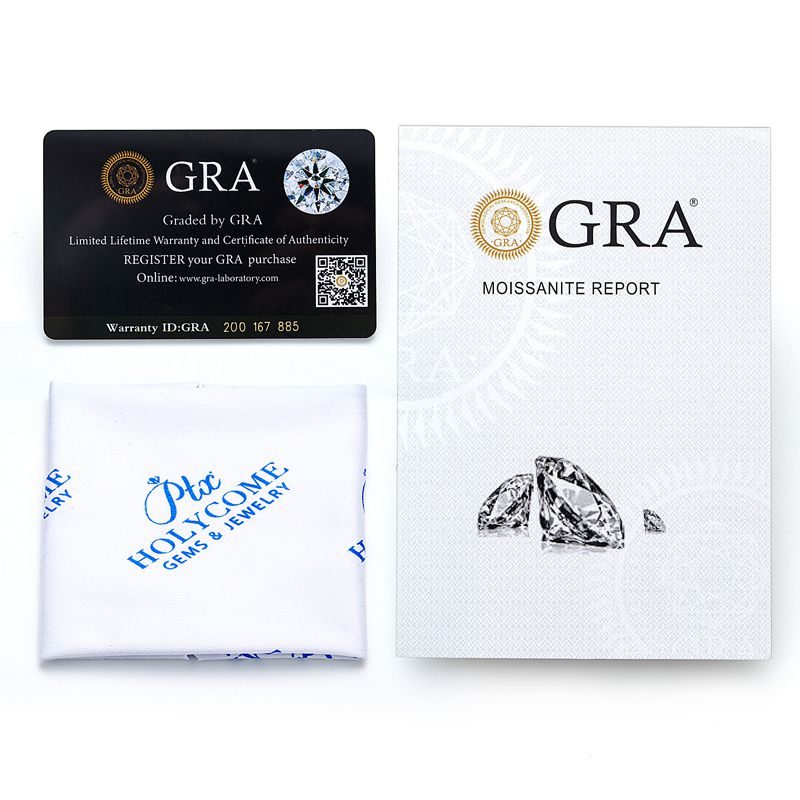
When a customer asks what color her stone is, 'D color' is the answer she wants to hear. It is also the truth, as long as you stocked D. Do not oversell the grade by comparing it to a diamond report; the customer does not need that conversation. Just hand her the GRA card, point to the D, and tell her the stone reads white against her ring. The card does the rest. You can review the current D-grade stone stock and the cards that ship with each size inside our wholesale loose stone range.
Side-by-side with a diamond sample
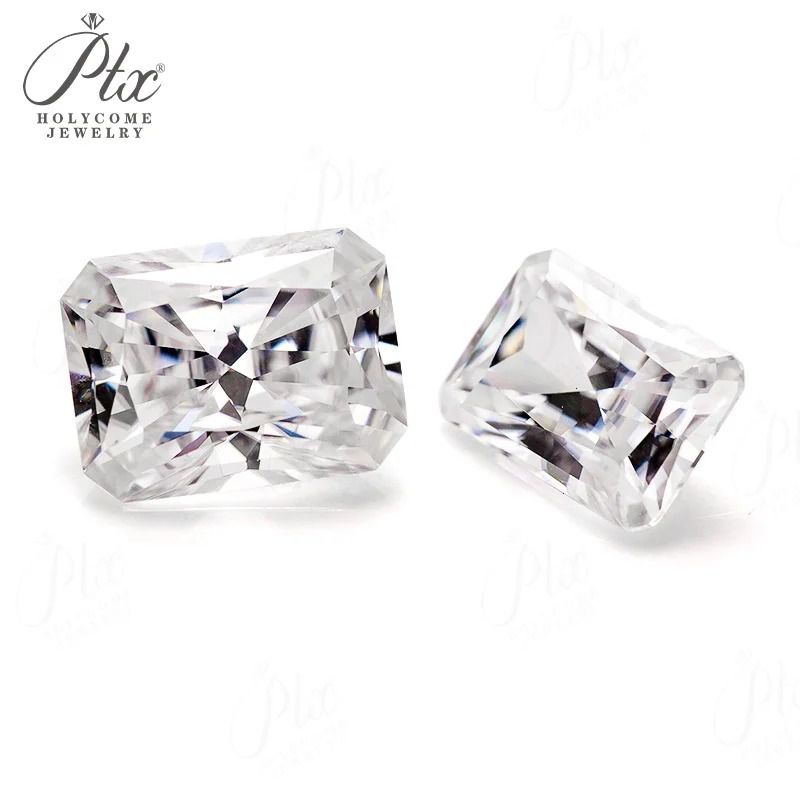
If you want to feel exactly what D-grade moissanite looks like, set one next to a known near-colorless diamond under the same light. Most customers cannot tell the two apart face-up, and that is the point of the grade. The moissanite actually shows more rainbow fire than the diamond, which is the characteristic customers notice and comment on. A small diamond comparison sample, even a 0.10ct melee, is worth keeping on the bench for exactly this moment.
When a customer asks whether her D stone is 'as white as a diamond,' the honest answer is that it reads white under most lighting, and that moissanite is not trying to be a diamond. It is its own material with its own sparkle. Framed that way, the question stops being a challenge and starts being a conversation about what the stone actually is.
Storage and lot tracking
Color drifts by production lot, which is why lot tracking matters. Write the lot number on the bag with the stones. When you reorder in six months, compare the new batch against the old one. If the new lot reads warmer, you now know why a customer noticed a difference between two solitaires she bought a year apart. That small record-keeping habit prevents the most awkward conversation in the store: a bride who compares her new ring against her old one and sees a tint shift.
The letter on the card is a starting point, not the final word. Your daylight lamp and your master reference stone are what actually tell you whether a batch is right for a bridal center. Buy D for the centers, accept E to F for accents, and reject any lot that drifts. That routine keeps the case consistent year after year.
Frequently Asked Questions
Is moissanite a good diamond alternative for retail buyers?
Yes for price-sensitive customers who want brilliance and hardness. Moissanite ranks 9.25 on the Mohs scale, holds up to daily wear and costs a fraction of a natural diamond of the same size, so it resells fast in bridal and fashion lines.
What is the minimum order for wholesale moissanite?
MOQ starts at 50 pieces per design for stock items. Custom cuts and private-label settings usually start at 100–300 pieces depending on the mold.
Do you provide certificates with moissanite stones?
Yes. Every parcel ships with GRA or IGI documentation listing carat weight, color grade and cut. We recommend passing the certificate to your end customer for trust.
How long does sample and bulk production take?
Samples ship in 3–5 days. Bulk runs take 15–20 days under 500 pieces, and 25–30 days for custom work.
Send your spec sheet — stone, cut, size, plating and quantity — and we will return a costed timeline.
Ask the workshop