Pricing is the first question every new wholesale buyer asks, and it is the hardest to answer from a public website because moissanite pricing depends on four variables at once: mm size, color grade, shape, and order volume. As a factory-direct exporter out of Wuzhou, GemWSL publishes tiered price lists for partners, but this article gives independent US jewelers the framework to read any price sheet — yours, a competitor's, or a trade-show quote — and understand what is fair.
Moissanite is priced by mm size, not just carat
Unlike diamonds, which trade on a GIA carat report, loose moissanite is cut to standard mm diameters that correspond to "carat equivalent" weights. A 6.5 mm round brilliant is universally marketed as a 1.0 carat equivalent; an 8.0 mm round is a 2.0 carat equivalent; a 9.0 mm round is roughly 3.0 carats. Wholesale price is anchored to mm size because that is what the factory cuts to and what the jeweler sets. The carat equivalent is a marketing label, not the pricing unit.
The size-based price curve
Per-stone wholesale prices rise steeply with mm size, because larger crystals are harder to grow clean and yield fewer finished stones per growth run. A rough curve for D VVS round brilliant stock looks like this, expressed in relative wholesale terms:
- 4.0-5.0 mm (0.25 ct equiv): lowest per-stone cost; stud earrings and small fashion stones.
- 6.5 mm (1.0 ct equiv): the volume anchor; most competitive pricing per stone because production runs are largest.
- 7.0-7.5 mm (1.25-1.5 ct): step up in price; the upsell tier.
- 8.0 mm (2.0 ct): roughly 2-3x the 6.5 mm per-stone price; halo and statement rings.
- 9.0 mm and above (3.0 ct+): premium tier; slow turnover, high margin.
The important insight for retailers: price per carat equivalent is actually highest at the small end and lowest at the 6.5-7.5 mm range. That means your best margin-per-stone story is the classic one-carat solitaire — not the giant 5-carat showcase piece.
Color and grade tier pricing
Within any mm size, the price moves with color and clarity grade:
- D color VVS: top tier. This is bridal stock and commands the highest wholesale price.
- E / F color VVS: near-colorless, usually 10-15% below D VVS, acceptable for fashion settings.
- G / H color VS: near-colorless eye-clean, another 10-15% off; strong for yellow and rose gold settings.
- Colored moissanite (teal, canary, grey, black): priced as specialty; often a premium over white stock because production volume is smaller.
Buyers sometimes ask whether they should save money by buying F color instead of D color. For a white solitaire, the answer is usually no — customers compare the stone against diamonds in the case, and a near-colorless grade can show. For a stone set in rose gold, F is fine and saves you margin.
Shape premiums
Shape affects price because cutting yield differs. Roughly:
- Round brilliant: lowest per-carat price because round cuts have the most optimized yield and the largest production volume.
- Oval, cushion, pear: small premium over round; demand-driven, especially for ovals.
- Emerald, Asscher, princess: variable; emerald cuts command a slight premium because they require higher clarity to look clean.
Order-volume tiers
The second pricing axis is how many stones you buy in a single PO. Factories publish volume tiers because larger runs cut cost per stone:
- 1-5 stones (sample/trial): near list price; meant for inspection, not margin.
- 10-50 stones (small parcel): standard wholesale; 20-30% off sample price.
- 50-200 stones (mid parcel): deeper discount; lets you specify shape mix.
- 200+ stones (bulk): best per-stone price; includes custom labeling and serialized certificates.
For a typical US independent boutique, the 30-50 stone parcel tier is the sweet spot: deep enough pricing to protect margin, shallow enough to keep inventory fresh.
How to read a competitor's quote
When you compare two wholesale quotes, do not just compare headline price per carat. Check:
- Is the quote per stone or per carat equivalent? These are not the same.
- What mm size is actually being quoted? A "1.0 ct" from one supplier may be 6.3 mm, from another 6.6 mm.
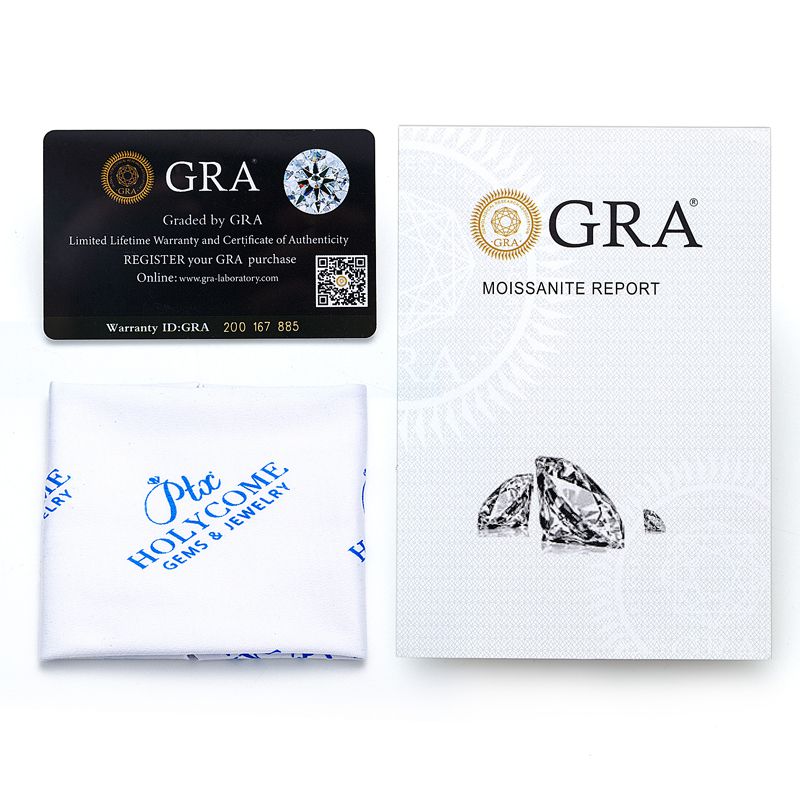
- Does the price include the certificate, or is the certificate a separate line item?
- What is the MOQ? A cheap per-stone price that requires 500 stones may be worse for your cash flow than a slightly higher price on a 30-stone parcel.
- Are returns and grading disputes handled, and what is the turnaround?
How moissanite pricing compares to lab-grown diamond
Independent jewelers often ask where moissanite sits in the broader price map. As of 2026, lab-grown diamond retail prices have fallen dramatically from their 2020 peaks, but a 1.0 carat equivalent D VVS lab-grown diamond finished into a solitaire still retails for several times the price of a comparable moissanite solitaire. Mined diamond is higher still. That gap is the entire commercial opportunity: moissanite is not competing on "same product, cheaper price" — it is competing on a price tier that no lab-grown diamond can reach while still looking credible in a bridal case. When you price your finished moissanite rings, anchor them just below the entry-level lab-grown diamond solitaire in your market, and the value story writes itself.
Landed cost vs stone cost
Remember that wholesale stone price is not the landed cost. Add tracked international shipping, any import handling, and the cost of your bench setting labor. For a 30-stone parcel, shipping is a small per-stone amortization, but for a one-stone trial it can dominate the invoice. Build your retail pricing from landed cost, not from the stone price on the supplier's PDF, and you will avoid the classic margin surprise at the end of the month.
Negotiating fair wholesale terms
Wholesale moissanite pricing is not as fixed as diamond pricing. A reliable factory expects partners to ask for volume tiers, mixed-shape flexibility, and a sample before bulk ordering. If you are placing repeat quarterly orders, ask for a standing partner price — most suppliers will lock a tier for accounts that reorder predictably and ship on time. Do not be afraid to walk away from a quote that feels high; the Wuzhou market is competitive, and a price that looks premium from one supplier may be standard wholesale from another.
GemWSL publishes a current price sheet for qualified wholesale partners, organized by mm size, grade, shape and parcel volume. Request the sheet when you are ready to build your next bridal inventory, and we can recommend a starting parcel sized to your store's sales velocity. We also publish quarterly updates so you can see how price tiers move with production volume, before you commit cash to a large reorder.