Loose Stones
Moissanite Fire vs. Brilliance: What Creates Its Sparkle
Put a moissanite next to a diamond under a bright light and the first thing most people notice is not which is cheaper. It is that the moissanite flashes color. Some buyers love the rainbow fire. Others wonder if it looks off. Understanding the optics behind the sparkle removes the guesswork and explains why a well-cut moissanite looks the way it does, and why two stones of the same material can look completely different in person.
Two words that describe sparkle: brilliance and fire
Brilliance is the white light that reflects back out the top of a stone when you look straight down. Fire, also called dispersion, is the splitting of white light into spectral colors, producing the rainbow flashes. A stone can be brilliant without being fiery, or fiery without being brilliant. The best stones balance both, and that balance comes from the cut, not from the material alone.
Why moissanite flashes more color than diamond
Two numbers drive the look. The refractive index measures how much a stone bends light as it enters. Diamond sits around 2.42. Moissanite is higher, near 2.65. A higher refractive index means light bounces around inside the stone more readily before escaping, which boosts brilliance and gives the stone its depth.
The second number, dispersion, measures how strongly the stone separates light into colors. Diamond's dispersion is around 0.044. Moissanite's is roughly double, near 0.104. That doubled dispersion is why moissanite shows more rainbow flashes than a diamond of the same cut. It is not a flaw. It is a physical property of the material, and it is one reason buyers are drawn to moissanite in the first place, because a smaller stone can out-sparkle a much larger diamond at a fraction of the cost.
How the cut shapes the result
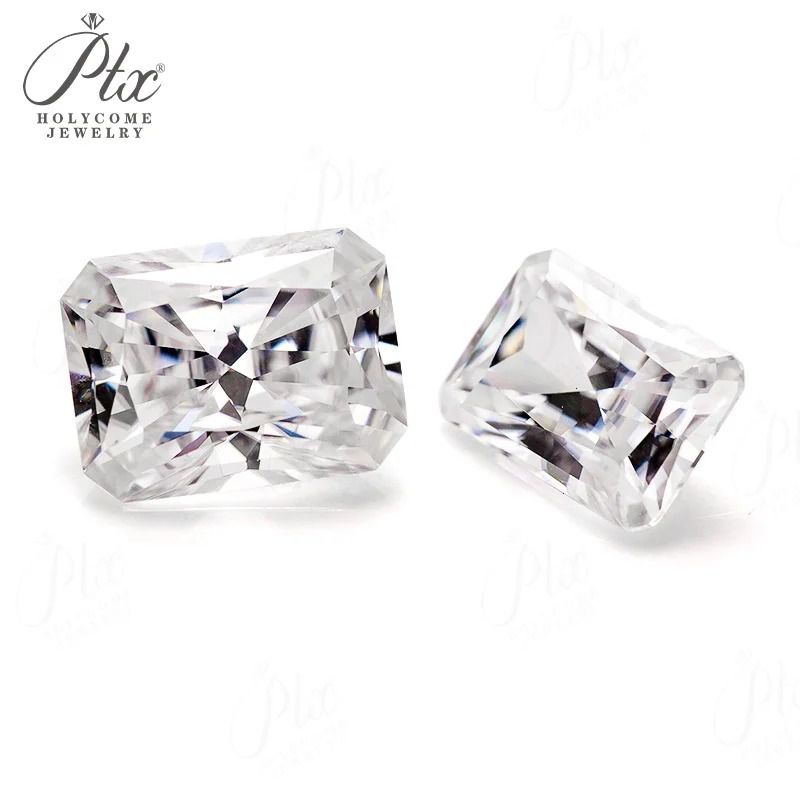
Optical numbers describe the raw material. The cut determines how that material performs. A round brilliant cut with well-proportioned facets returns light evenly and balances fire against brilliance. An emerald or Asscher cut, with large open facets, shows contrast patterns rather than scattered flashes, and the higher dispersion reads as subtle color play within each step.
Too-deep or too-shallow proportions cause light leakage, which shows up as a dark area in the center of the stone. Our guide on moissanite shape comparison walks through how each shape handles light. Buying from a supplier who grades cut proportion, not just color and clarity, is what separates a lively stone from a dull one.
Why some moissanite looks dull indoors
Buyers occasionally report that a moissanite looked dull in indirect indoor light. That is usually a cut problem, not a material problem. Very shallow stones leak light, and the high dispersion can wash out in diffuse indoor lighting where there is no strong light source to split. Under sunlight or a direct bulb, the same stone can come alive. Ask to view a stone under both a spotlight and a soft neutral light before committing, and compare it against a known mm size so the proportions are honest. A reputable supplier will photograph the stone under both conditions rather than only under ideal lighting.
What to expect when worn
In real wear, moissanite reads as a bright, lively stone. The rainbow fire is most visible in motion, when the wearer turns her hand and catches a light source. Indoors under office lighting, the effect softens to a clean white brilliance that most onlookers read simply as a bright, well-cut stone. Many buyers actually prefer the extra sparkle because it means a smaller moissanite center can out-perform a larger, less well-cut diamond on the finger.
Does extra fire ever read as too much?
A small number of buyers expect the quieter, whiter sparkle of a classic diamond and are surprised by moissanite's color flashes. That reaction is almost always about expectation rather than quality. Oval, pear, and marquise cuts tend to show the dispersion more strongly because the elongated shape lets light travel farther inside the stone, while round and cushion cuts balance it more evenly. If a bride wants a subtler look, a round brilliant in a near-colorless grade is the most diamond-like starting point. If she wants the most sparkle per dollar, the elongated shapes lean into the fire and deliver a dramatic, light-catching stone. There is no wrong answer, only a choice about which look she wants to wear.
The bottom line
Moissanite's sparkle comes from a higher refractive index and roughly double the dispersion of diamond. That is why it flashes color and why it looks so alive in motion. The cut determines whether that physics is expressed as balanced brilliance or as a dull, leaking stone. Buy by proportion, view the stone under mixed lighting, and the result will be a ring that draws attention for the right reasons.
For third-party reference, the Wikipedia article on moissanite details moissanite’s discovery, optical properties and use in jewelry.
Frequently Asked Questions
Is moissanite a good diamond alternative for retail buyers?
Yes for price-sensitive customers who want brilliance and hardness. Moissanite ranks 9.25 on the Mohs scale, holds up to daily wear and costs a fraction of a natural diamond of the same size, so it resells fast in bridal and fashion lines.
What is the minimum order for wholesale moissanite?
MOQ starts at 50 pieces per design for stock items. Custom cuts and private-label settings usually start at 100–300 pieces depending on the mold.
Do you provide certificates with moissanite stones?
Yes. Every parcel ships with GRA or IGI documentation listing carat weight, color grade and cut. We recommend passing the certificate to your end customer for trust.
How long does sample and bulk production take?
Samples ship in 3–5 days. Bulk runs take 15–20 days under 500 pieces, and 25–30 days for custom work.
Send your spec sheet — stone, cut, size, plating and quantity — and we will return a costed timeline.
Ask the workshop