Engagement Rings
Marquise Cut Engagement Rings: Finger-Elongation Tricks Buyers Stock
A boutique buyer from Manchester laid three marquise samples on our comparison tray last November. All three were 2-carat equivalent moissanite, all near-colorless, all graded eye-clean. The first looked elegant and slim on the size 7 demo hand. The second looked wide and blunt. The third looked lopsided, with one point visibly longer than the other. She wanted to know which one to order in bulk. The answer was none of those three as-worn; the answer was ordering the right length-to-width ratio and checking symmetry before the stones ever reach a setting.
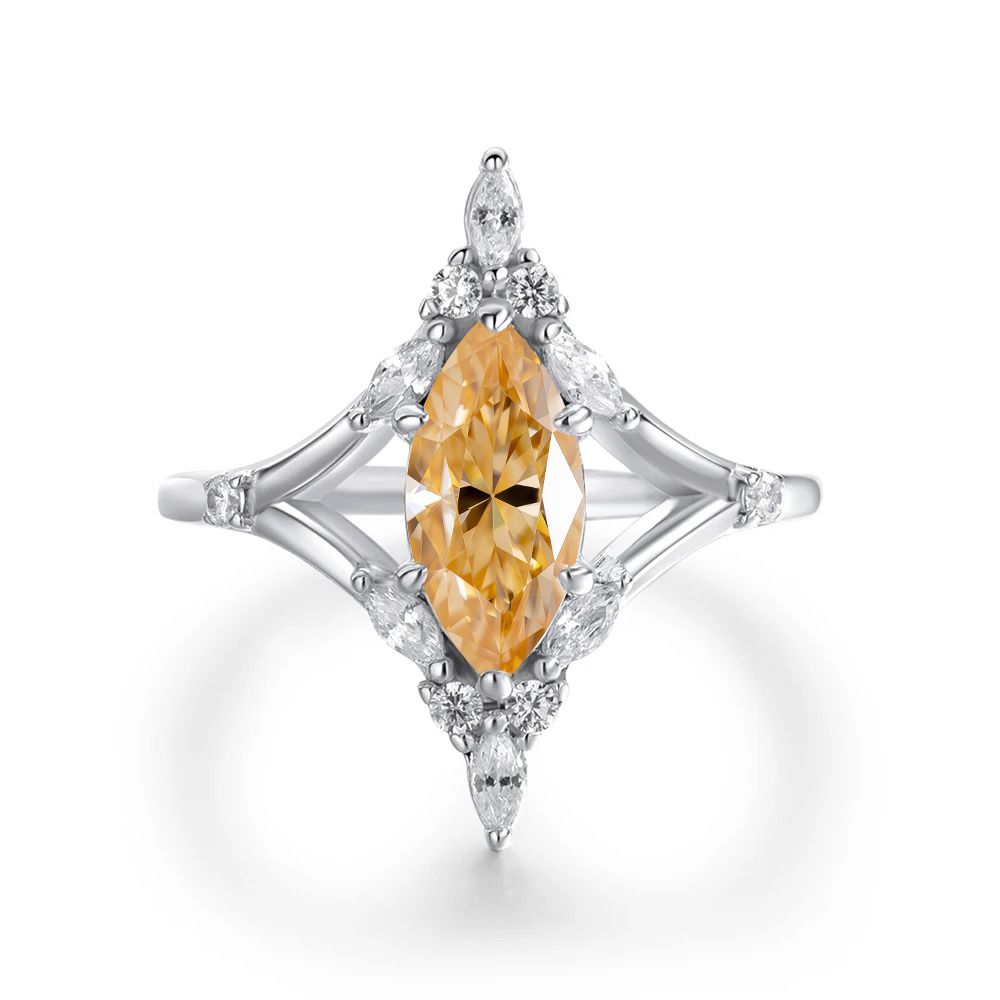
The marquise (or navette) is the single most finger-lengthening cut in a bridal case. It is also the easiest cut to get wrong. For a wholesale buyer, stocking it correctly means controlling three numbers: the length-to-width ratio, the table-to-pavilion balance, and the symmetry of the two points. This guide walks through each.
The length-to-width ratio that slims the finger
A marquise is an elongated oval with pointed ends. Its visual power comes entirely from how stretched it is. Industry convention, as the GIA 4Cs framework describes, treats shape proportion as a gradeable attribute. In practice, three ratio bands matter:
A ratio of 1.75 to 1.90 reads as a "soft" marquise, closer to an oval, and it suits women who want elongation without drama. A ratio of 1.90 to 2.10 is the sweet spot: long enough to slim the finger, short enough to stay sturdy at the points. A ratio above 2.15 looks needle-like, over-fires brilliance, and raises the risk of the two fragile points chipping in daily wear. Stock the 1.90-2.10 band as your core SKU; the 1.75-1.90 band as your conservative option.
Why point symmetry sells a marquise
The marquise has two points, and buyers notice within one second when they are uneven. An off-center length of even 0.3mm is visible on the hand but invisible on a certificate. Before stocking a tray, run a quick symmetry check: lay the stone flat, sight along the long axis, and confirm both tips land on the same center line. Reject any stone where one point tilts left or right. Moissanite is cut to tighter commercial tolerances than mined diamond, which is why a factory-direct buyer can demand point-symmetric stones at a fraction of the cost a retail consumer would pay.
Setting tricks that protect the points and add length
The points are the weak zone. A V-shaped (bear-claw) setting cups each tip and takes the brunt of knocks. A plain prong leaves the point exposed and invites chips. For elongation, run the long axis straight down the finger, point toward the knuckle. Pair the setting with a slim 1.8-2mm shank: a thick band visually shortens the finger and cancels the whole point of the cut. Compare how oval and round cuts read on the hand so your staff can explain why the marquise elongates while a round does not.
Which finger sizes should a buyer demo on?
Stock your sample tray in size 6 and size 7. A marquise that looks balanced on a size 6 finger will look dramatically slimmer on a size 7. Roughly two-thirds of bridal customers fall between size 5.5 and size 7.5, so those two demo sizes cover the visual range. If your market skews to larger hands (size 8+), add a size 8 demo stone at the 1.90 ratio, because elongation matters most on wider fingers.
Ordering the right ratio in bulk
When you place a standing order, split the quantity across the two ratio bands rather than committing all budget to one. A typical boutique mix is 60% in the 1.90-2.10 sweet spot and 40% in the softer 1.75-1.90 band. That covers the customer who wants drama and the customer who wants elegance, without overstocking either. Request a ratio sheet with every shipment so your staff can talk numbers on the floor.
What marquise ratio is most flattering on short fingers?
The 1.95-2.10 band. A longer, slimmer stone draws the eye down the finger and makes the knuckle-to-tip distance read longer. Avoid ratios under 1.85 on short, wide fingers; they read as a fat oval and lose the elongating effect.
Do marquise stones chip more easily than ovals?
The points chip more readily, yes. That is why we ship marquise moissanite in V-tip bear-claw settings rather than open prongs. Moissanite's hardness (9.25 on Mohs) is second only to diamond, but a pointed gable is always a stress riser regardless of material.
Can a marquise be worn alongside a straight wedding band?
Not flush. The tapered ends leave gaps. Most brides pair a marquise with a curved wedding band that follows the outline, or a contour band. Explain this up front so customers do not expect a straight band to sit tight.
Does marquise moissanite look larger than a round of the same carat?
Yes. A marquise has a larger face-up footprint than a round brilliant of equal weight, typically 10-15% more table area. That is a strong wholesale talking point: the customer gets a bigger-looking stone at a lower carat weight.
Wholesale note: HOLYCOME cuts and pre-sets marquise moissanite from 8x4mm to 14x7mm in the 1.90-2.10 ratio band, with V-tip settings and private-label packets. If your boutique wants a finger-slimming SKU that photographs long, read our moissanite engagement guide, then request a sample tray. Pair it with bridal sets that stack on one finger.
Frequently Asked Questions
What ring sizes can you supply in bulk?
US sizes 5–12 including half sizes. Send a size breakdown with your order and we cast to that curve; comfort-fit inner bands reduce resize requests.
Can I order a mixed size run instead of one size?
Yes. Mixed runs are standard for wholesale: specify quantity per size and we pack and label by size at no extra labor cost.
What is the MOQ for custom ring designs?
50 pieces per design for existing molds; 100–300 pieces when a new mold or CAD model is required.
How should I price rings for retail margin?
Most partners use a 3–4x markup on FOB cost for sterling and 2.5–3x for moissanite solos, which keeps landed cost under 30% of retail.
Send your spec sheet — stone, cut, size, plating and quantity — and we will return a costed timeline.
Ask the workshop