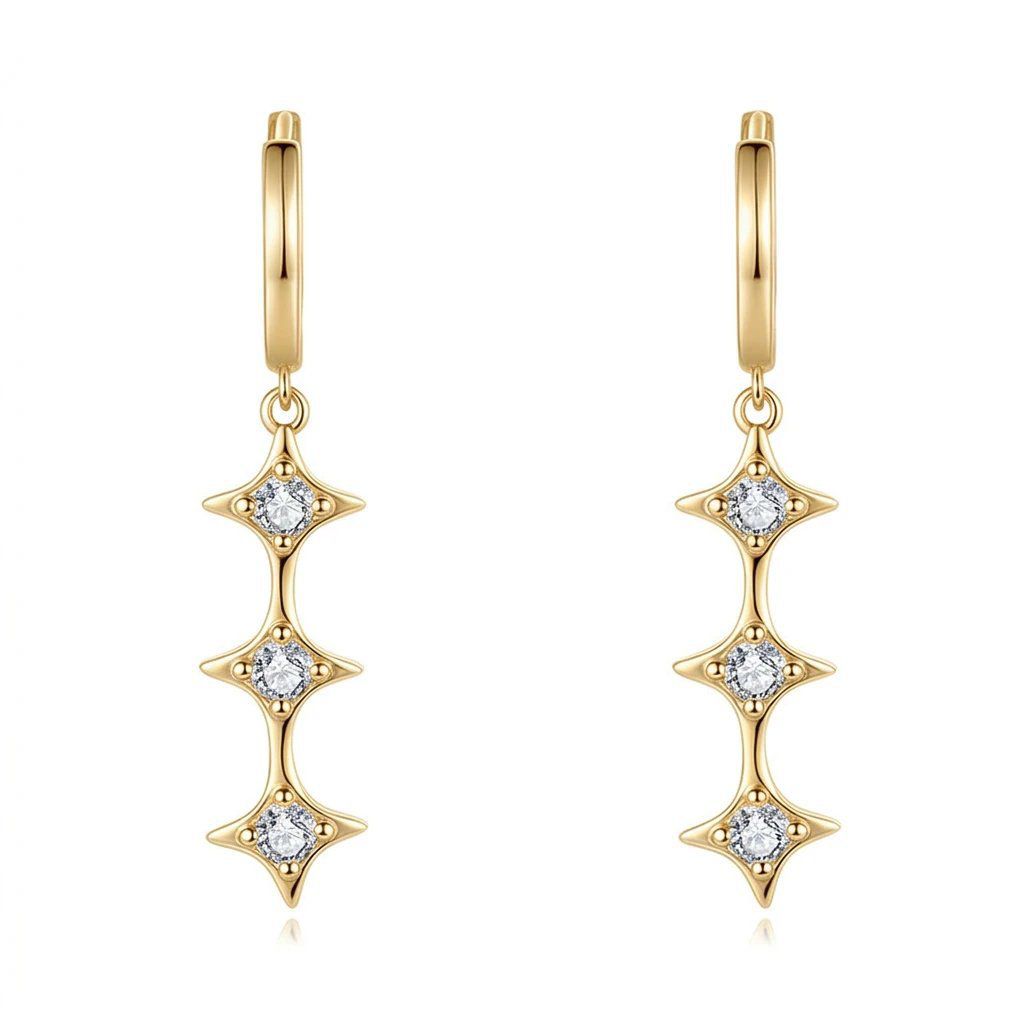
The earring market in the United States has moved past the single-stud era. Walk into any boutique or browse a jewelry feed, and the same pattern repeats: multiple piercings, layered lengths, and small articulated hoops stacked along the ear. For wholesale buyers, this shift means huggie earrings and small hoops are no longer a trend to watch. They are a category you should be deeply stocked in right now.
Why huggies and small hoops are having a moment
Huggies are small, hinged hoops that "hug" the earlobe closely to the skin. Their compact size makes them ideal for second, third, and cartilage piercings, and they pair naturally with studs without overwhelming the face. Small hoops, generally under 20 mm in diameter, offer the same versatility in a slightly more open silhouette.
Several cultural and retail forces are driving demand. Multi-piercing has become standard rather than alternative, especially among Millennial and Gen Z shoppers. Work-from-home jewelry styling has encouraged people to invest in small pieces they can wear every day, rather than one statement pair for a single event. And the rise of sterling silver as a wearable, affordable fine-metal standard has put hoops within reach of younger buyers who would previously have reached for fast-fashion alloy pieces and then suffered the green-earring problem that comes with them.
The shapes your case should carry
A complete wholesale huggie and small-hoop assortment covers a range of silhouettes. You do not need dozens of SKUs; you need the right few that stack together. Overloading the case with one-off designs makes it hard for customers to choose and makes reordering a nightmare.
- Plain polished huggies in 10 mm and 12 mm diameters, rhodium finished. These are the repeat buyers, the everyday pair customers never take off.
- Micropavé huggies set with tiny moissanite or CZ stones along the front curve. They transition from office to evening and photograph beautifully on social media.
- Small plain hoops in 15 mm and 20 mm, available in rhodium and gold vermeil. These sit just below the lobe and layer with huggies.
- Hoop with charm styles, where a small removable or fixed dangle (a heart, a star, a solitaire) hangs from a plain hoop. They give you a higher-ticket SKU without a separate design line.
- Inside-out hoops, pavé set on both the front and back curve, for customers who want sparkle from every angle.
Metal and finish decisions
For an American independent retailer, 925 sterling silver remains the safest base. It is affordable, durable enough for daily wear, and carries the "real silver" trust signal that fast-fashion brands cannot replicate. From that base, finish drives the assortment:
Rhodium plating gives a bright white, tarnish-resistant surface that matches moissanite and cool skin undertones. Gold vermeil — a thick gold layer over sterling silver — answers the warm-metal customer without the price point of solid gold. Offering the same silhouette in both finishes doubles your sell-through on a single design, because shoppers tend to buy the finish that matches their existing watch or wedding band. If you only stock one finish, you are turning away roughly half of your walk-in traffic on price-matching instinct alone.
Quality checks that separate good hoops from bad
Small hoops live or die by their hinge. A cheap huggie pinches, opens by itself, or catches on hair. When you order a sample run, test every size the same way: open and close the hinge fifty times, listen for a crisp click, and check that the inner curve is smooth against the finger. Inspect the plating under a bright light for uneven coverage on the hinge gap, where cheap plating often misses. A hoop that looks perfect in a sealed bag but scratches or pinches after a week will generate returns that erase your margin.
Also check the post and backing. A huggie that uses a simple hinged closure rather than a separate push back is easier for customers to put on one-handed, which matters for the high-piercing positions where they cannot see their own ear.
Merchandising that moves product
Huggies are sold by how they look together, not how they look alone. Use a bust or ear-form display at counter height so customers can see the stack. Tell a story on your card: "Lobe huggie, second-piercing huggie, cartilage hoop." Train your staff to suggest the second and third piercing pairing when a customer buys a single pair. Most shoppers will leave with two pairs if the second is shown on the same tray.
Because these pieces are relatively low in price, impulse attach is powerful. A customer in to pick up a solitaire stud will almost always add a small plain hoop when it is placed on the same tray. Keep your huggie tray near the register, not buried in the case. The grab-and-go nature of this category rewards visibility more than it does careful deliberation.
Seasonality and restocking
Huggies sell year-round, but they spike in gift season. Plain hoops are a top-seller in November and December because they suit a wide age range and a wide size range. Pavé and charm versions lift in late spring, ahead of graduation and wedding-party gifting. Plan your orders so that plain hoops are deepest in the fourth quarter, and pavé styles are refreshed in the second quarter.
Sourcing factory-direct
Wuzhou workshops have spent decades refining small-hoop manufacturing, particularly the hinge mechanisms that separate a comfortable huggie from one that pinches. When you buy wholesale, ask specifically about the hinge and post design: a snug click closure, smooth inner curve, and consistent earring back. Inspect a sample run for plating uniformity, because small hoops show fingerprints and uneven finish more readily than flat studs. Build your huggie program around repeat silhouettes rather than one-off designs. Customers who love their 12 mm pavé huggie will come back for the same size in gold vermeil, in a plain finish, and as a gift. That recurring demand is what turns a small category into a stable, profitable earring business.
One more merchandising lesson worth internalizing: huggies are social. Customers photograph their stacked ear on the way out, and that photo is free advertising for your store. Brand the ear-form display subtly, and you will start seeing your own trays appear on local social feeds within a few weeks. Encourage staff to suggest the stack rather than the single pair, and to mention that the plain hoop and the pavé hoop are designed to sit together. The customer who leaves with three pairs is not just a higher ticket; she is a walking display for the next multi-piercing shopper who walks in behind her.