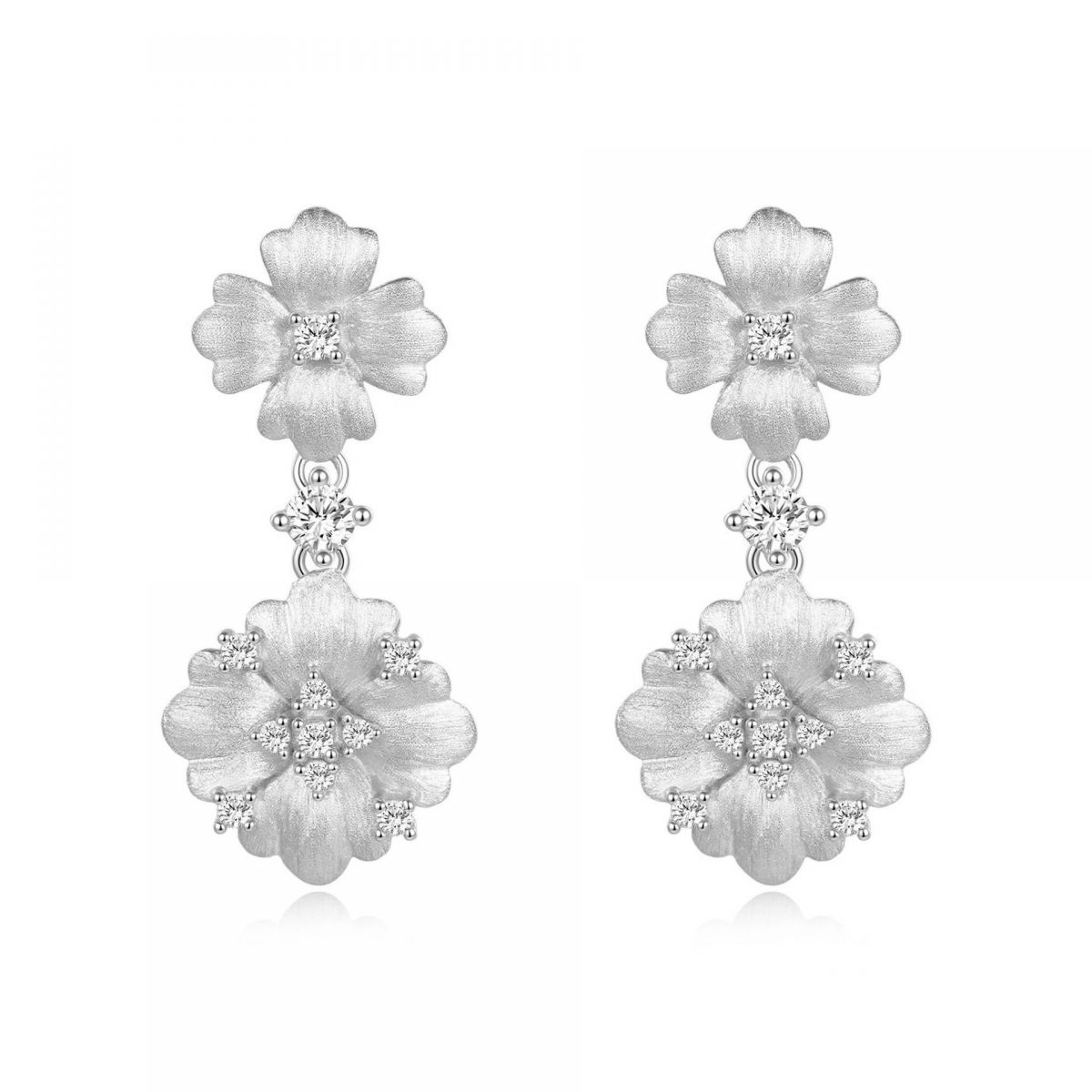
Bridal season is the most profitable window on the jewelry calendar, and for many U.S. independent jewelers, the piece that closes the wedding-day sale is not the ring. It is the earrings. A bride who has spent months choosing a gown, a veil, and a hairstyle will spend remarkably little time deciding what hangs from her ears — and then feel that choice every time she looks in the mirror, and every time she looks at her wedding photos. Stocking the right bridal drop and chandelier earrings turns a one-time ring buyer into a repeat customer who brings her bridesmaids, her mother, and her future daughter.
Why drop and chandelier styles win bridal sales
Studs are timeless, but they do not photograph. Drop earrings — a stone or cluster suspended below the lobe — catch light from every angle and elongate the face. Chandelier earrings take that further, with multiple tiers or branches that move as the bride turns her head. In wedding photography, where every detail is lit and zoomed, these silhouettes read as intentional, luxurious, and coordinated with the gown.
Bridal buyers are also less price-sensitive than everyday shoppers. They are planning a single event and will pay for a piece that feels special, even if they never wear it again. This is your highest-margin earring category of the year, and it deserves its own display, not a corner of the stud tray. A dedicated bridal earring bust, lit softly, lets the bride imagine herself at the altar far more effectively than a flat tray behind glass.
The silhouettes your bridal case should carry
A focused bridal earring assortment covers a range of necklines and hairstyles. You do not need fifty designs; you need the eight or nine that cover every gown a bride might bring in.
- Single linear drop: one moissanite or pearl-style drop on a sterling silver post. Works with V-necks, strapless gowns, and updos. The safest, most reorderable bridal SKU.
- Teardrop cluster drop: a cluster of small stones arranged in a teardrop shape. Reads as a statement without overwhelming a high neckline.
- Bridal chandelier: a two- or three-tier cascading design, rhodium plated, set with micropavé moissanite. This is the "wow" piece for ballgowns and formal evening weddings.
- Minimalist bar drop: a thin horizontal bar or marquise line, for the modern or boho bride who wants sparkle without fuss.
- Detachable two-way earring: a stud on the front with a removable drop on the back, so the bride can wear it as a stud for the ceremony and as a drop for the reception. A genuine upsell.
- Leaf or vine motif drop, for garden and outdoor weddings, where organic shapes suit the setting better than a geometric cluster.
Moissanite over diamond for bridal
More brides are choosing moissanite for their wedding-day earrings, and for practical reasons. Moissanite fires more than diamond under bright wedding photography, where ring lights and flash can make a real diamond look flat. It costs a fraction of a comparable stone, so a bride can wear a 3 ct teardrop cluster for the price of a small diamond stud. And because it is not an heirloom piece, she does not need to insure a small fortune for a single day.
As a retailer, you can market this honestly: tell her she can have the look of a 5 ct chandelier within a realistic wedding budget. That conversation is far easier than trying to stretch a diamond budget, and it positions you as the store that says yes rather than the store that says "for that, you'd need to spend more."
Matching earrings to gown, veil, and hair
The most useful thing your staff can do is ask about the dress before showing earrings. A high neckline calls for a longer drop to balance the covered shoulders. A strapless gown opens the neck and shoulders, so a shorter, clustered drop reads better. A veil that sits over the ears requires an earring that is either small enough to sit under the tulle or dramatic enough to show beside it. An updo exposes the whole ear, which is the moment a chandelier earns its keep; loose hair covers the lobe, so a longer drop is needed to peek through.
Train your staff to ask these three questions at the start. It positions you as a bridal specialist rather than a salesperson, and it dramatically improves the chance the bride loves the piece on the day itself.
Metal and finish for the American bride
Rhodium-plated 925 sterling silver is the default for bridal white. It matches platinum and white-gold rings, photographs cleanly, and avoids the yellow cast that cheap silver can show on camera. For warm-toned brides or those marrying in gold-band rings, offer a small gold-vermeil version of the same drop design. Keeping the silhouettes consistent across finishes means your bridal display looks curated, not cluttered. Backings should be screw or lock style on every bridal pair. A bride will not be pinching a friction back in a wedding dress, and the security story is part of the sale.
Extend the sale beyond the bride
When a bride buys, her mother and her bridesmaids are standing next to her. Stock two lower-priced tiers in the same aesthetic: a simple pavé stud or small drop for bridesmaids, and a modest crystal drop for the mother of the bride. Train your staff to show these at the same time. The bridal earring sell-through rarely stops at one pair in the room. Bridesmaids especially buy in groups, and a single bride appointment can turn into four or five earring sales within minutes.
Planning your bridal buy and wedding calendar
Order bridal drop and chandelier styles four to five months ahead of peak wedding season. In the U.S., the busiest bridal buying window runs from January through May for June-through-October weddings, with a secondary push in fall for holiday and New Year's Eve events. Keep your opening buy balanced: roughly half single drops, a quarter chandeliers, and a quarter minimalist and detachable styles. Source factory-direct from Wuzhou, where moissanite setting and sterling silver finishing are mature, and you will have inventory that photographs, fits, and sells at the margin your store needs. A well-planned bridal earring program is the difference between a store that sells rings and a store that sells the whole wedding.
Finally, remember that a bride rarely buys earrings on her first visit alone. She comes with her maid of honor, her mother, or her future sister-in-law, and that group is watching how you treat the decision-maker. Offer a quiet seat, a hand mirror, and a few neutral suggestions rather than pushing the most expensive piece. The bride who feels cared for will bring that whole group back for gifts, and she will tell every engaged friend she knows that your store is the one that helped her look right on the day. That word of mouth is worth more than any bridal-show booth you could rent.