Loose Stones
Cushion & Asscher Cut Moissanite: Parcel Buying Guide
Round brilliant moissanite will always be the volume shape, but the fastest-growing requests in the loose stone market are fancy cuts—especially cushion and Asscher. Brides scrolling wedding inspiration keep landing on a soft, pillow-shaped cushion halo and a step-cut, glassy Asscher, both of which read vintage and distinctive. For buyers who want to offer those looks without committing to custom cutting, buying these shapes in parcels is the practical route—if you know what to inspect. We covered the shape landscape broadly in our moissanite shape comparison; this guide goes deep on the two fancy cuts gaining the most traction.
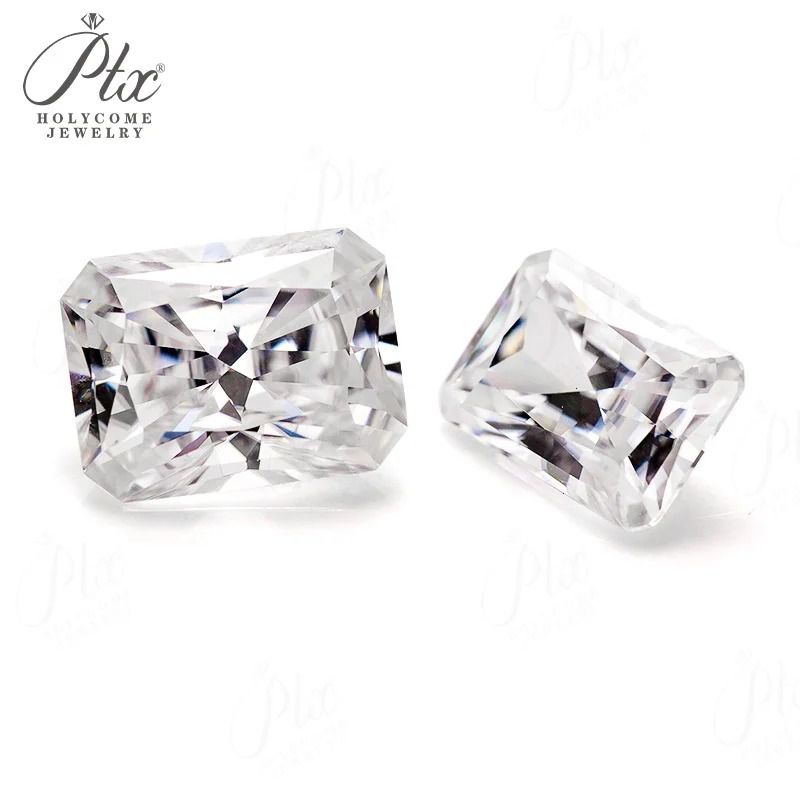
The cushion cut is a square or slightly rectangular stone with rounded corners and large facets that throw a soft, pillow-like glow. It is the most romantic of the fancy shapes and pairs naturally with a halo, because the rounded corners sit inside a circular border beautifully. Cushions can be "chunky" (fewer, larger facets) or "ice" (many small facets), and the two look quite different. Chunky cushions show warmer, softer light; ice cushions sparkle like a shower of tiny mirrors. Decide which your customer base prefers before ordering, because they do not mix well in the same tray.
The Asscher cut is a square step-cut, related to the emerald cut but rotated and more compact. It is known for a deep, glassy, hall-of-mirrors look and a strong "X" pattern at the center. Asschers read architectural and art-deco—think 1920s glamour—and they photograph with an almost liquid clarity. They show color and inclusions more honestly than a round brilliant, because the step facets do not disguise them. That means clarity and color selection matter more for Asschers than for rounds.
Buying parcels of either shape requires a slightly different eye than buying rounds. With rounds, you can rely heavily on the mm size and a top-down photo. With cushions and Asschers, you must also check the length-to-width ratio. A cushion that is too square looks stocky; one that is too rectangular reads as an old mine cut. An Asscher should be nearly square, with only a slight rectangle. Ask your supplier for the exact L/W ratio on each stone, and reject parcels where every stone has a different proportion—that inconsistency makes matched pairs (for earrings) almost impossible.
Color checking is critical for step cuts. Because the open step facets show the stone's body color directly, a tint that is invisible in a round brilliant can be obvious in an Asscher. When buying D-color parcels, insist on side-by-side comparison stones or a color-checker photo against a white background. A cushion hides color a little better due to its facet pattern, but still benefits from high color grades for bridal-grade white. We explain the grading scale in our moissanite color guide; the rule here is simple—buy one grade higher in color than you would for a round.
Setting choices follow the shape. Cushion cuts shine in halos and bezels, and the rounded corners look beautiful in a four-prong setting that leaves the corners exposed. Asschers love a square emerald-style halo, a bezel, or a clean four-prong solitaire that lets the step-cut lines breathe. Avoid heavy pavé on an Asscher—the busy band competes with the architectural top. For a refresher on setting mechanics, see our engagement ring setting guide.
Parcel quantities and MOQs. Fancy cuts usually have slightly higher minimums than rounds because production runs are smaller. Start with a modest parcel—two or three cushions across popular sizes (5x5, 6x6, 7x7) and one or two Asschers—before scaling up. These shapes sell to a more specific bride, so a huge parcel ties up capital that turns slowly. The good news is that margins on fancy cuts are typically better, because fewer retailers stock them and the bride who wants one is not price-comparing at a big-box store.
Verify each stone under magnification. Cushions can show a dark area in the center if the cut is too deep—the dreaded "nail head" or "dark cushion." Asschers can show windowing (a see-through, flat center) if cut too shallow. Either issue kills the stone's appeal and is hard to spot in a small listing photo. Always request a video of the stone face-up under light, rotating, before committing to a parcel. A reputable supplier provides this willingly; hesitation is itself a signal.
For earrings and three-stone pieces, matched pairs of cushions and Asschers are gold. A matched pair of Asscher studs in a 6mm size is a high-ticket, low-volume item that draws a specific customer. If your supplier can pair stones from the same parcel, the color and proportion will match naturally. That matching capability is worth more than a tiny price-per-carat discount.
Cushion and Asscher cuts are not for every tray, but for a retailer positioning itself as bridal-forward, they are the shapes that get browsers to stop scrolling. Buy conservatively, check proportions and color carefully, and let the vintage, architectural look do the selling. The brides who ask for these cuts are looking for something they cannot find everywhere—and that is exactly the customer a small jeweler wants to keep.
Gemstone grading terminology used here follows the Gemological Institute of America’s gem encyclopedia.
Frequently Asked Questions
Is moissanite a good diamond alternative for retail buyers?
Yes for price-sensitive customers who want brilliance and hardness. Moissanite ranks 9.25 on the Mohs scale, holds up to daily wear and costs a fraction of a natural diamond of the same size, so it resells fast in bridal and fashion lines.
What is the minimum order for wholesale moissanite?
MOQ starts at 50 pieces per design for stock items. Custom cuts and private-label settings usually start at 100–300 pieces depending on the mold.
Do you provide certificates with moissanite stones?
Yes. Every parcel ships with GRA or IGI documentation listing carat weight, color grade and cut. We recommend passing the certificate to your end customer for trust.
How long does sample and bulk production take?
Samples ship in 3–5 days. Bulk runs take 15–20 days under 500 pieces, and 25–30 days for custom work.
Send your spec sheet — stone, cut, size, plating and quantity — and we will return a costed timeline.
Ask the workshop