Wedding Rings & Bands
Wholesale Wedding Band Metals and Widths: What Brides Buy
Wedding bands are the quiet repeat business of a bridal shop. The engagement ring is the dramatic sale; the band is the sale that happens again when a husband brings his wife's sister in, and again when a groomsman needs a matching set next spring. Stocked right, bands turn faster than solitaires because the decision is smaller and the customer is usually already decided on a metal. Stocked wrong, you are left holding 47 size-9 comfort-fit rings no one asked for.
The three widths that pay rent
Walk into a bridal store and the band wall looks like hundreds of choices. On the shelf that actually turns, it is closer to three. Women in their late twenties to mid thirties buy 2mm and 3mm bands to sit flush against a solitaire; men buy 4mm to 6mm comfort fits. If you stock only three widths, you still cover about 80% of the demand in a typical US mall or downtown shop.
| Width | Worn by | Profile | Wholesale band cost (925 silver) |
|---|---|---|---|
| 2.0 mm | Women, stackable | Flat, comfort fit | $6 - $11 |
| 3.0 mm | Women, classic | Comfort fit | $8 - $14 |
| 4.0 mm | Men, slim | Comfort fit | $11 - $18 |
| 6.0 mm | Men, standard | Comfort fit | $15 - $26 |
Metal stories that sell at the counter
For most US retailers entering bridal wholesale, plated 925 silver is the entry tier. It carries a .925 stamp, it is nickel-free, and it holds rhodium plating well enough to survive the first year of wear. When the customer wants a 'real white gold' feel without the gold price, solid 10k or 14k white gold is the upgrade. Rose and yellow tones follow the same ladder. Do not try to stock all four tones at every width on day one. Pick the tone your local customer already wears - most US coastal and suburban shops skew white or rose - and expand after one selling season.
- Platinum-plated 925 silver - best margin, easiest to resize, ideal for the entry bridal customer.
- Solid 10k white gold - the upgrade tier for customers who will not wear plated jewelry.
- Rose gold vermeil - strong in southern and suburban markets, weaker in corporate downtowns.
- Tungsten and ceramic men's bands - separate category, not bridal; do not mix them into the bridal wall.
Plain versus accent bands
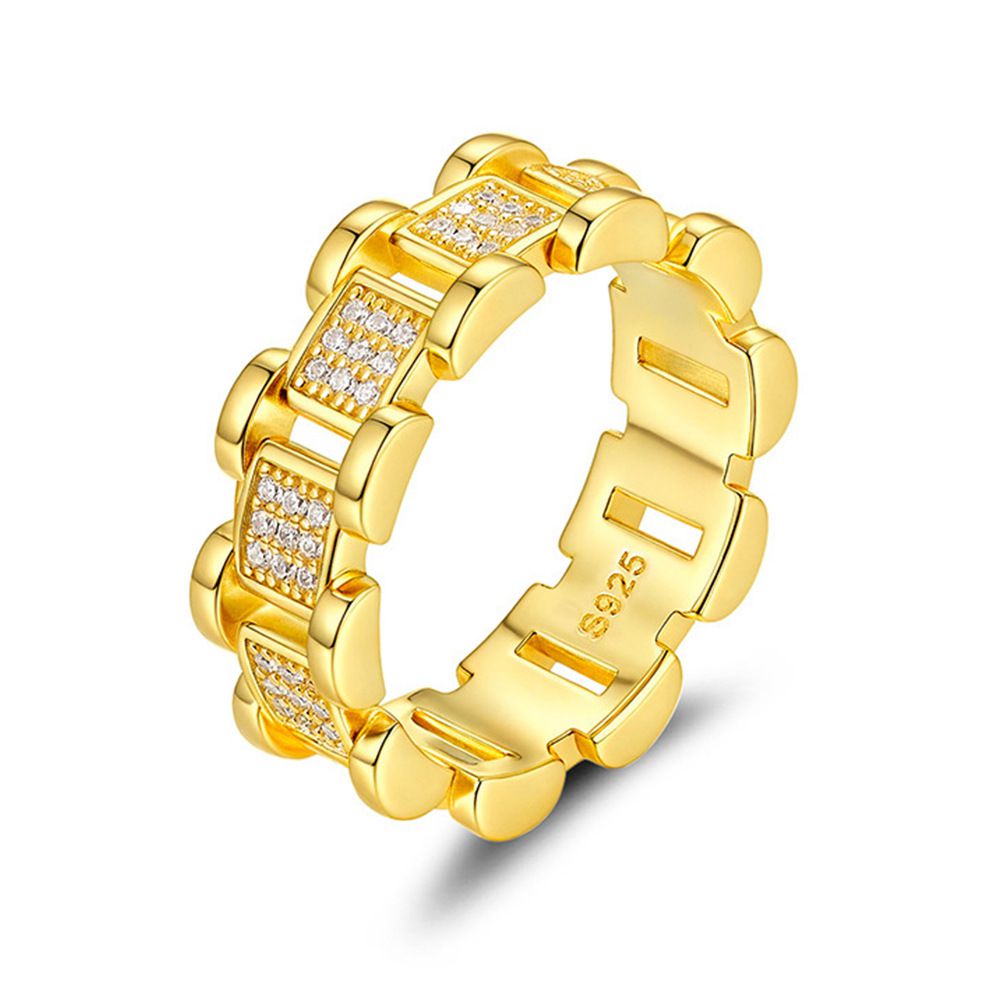
About two-thirds of women buying a band want a plain comfort fit that sits flush with the engagement ring. The remaining third wants a half-eternity or pavé band with small moissanite accents running along the top half. We stock both. The accent band uses 1.0mm to 1.3mm moissanite stones set in shared prongs, and it wholesales at roughly $18 to $32 depending on stone count. It gives the bride a 'wedding set' look without the price of a full eternity band, and it photographs beautifully in the engagement suite.
Size distribution and reorder logic
The single most expensive mistake a band buyer makes is stocking evenly across sizes. Women's bands move hardest in sizes 6 and 7; men's bands move hardest in sizes 9 and 10. Open with two pieces per size in the middle, one piece at the edges, and reorder the moment a middle size drops to zero. Our band MOQ is five pieces per SKU and in-stock sizes ship in three to seven business days. Resizing a 2mm comfort fit is a ten-minute bench job, so you can afford to keep edges thin and pull from stock when a customer walks in with a size 4.5.
You can see the current band assortment inside our wholesale wedding ring range before you commit to a trial order.
Plating care and the warranty conversation
Rhodium plating on a .925 silver band wears. How fast depends on the wearer: a woman who washes her hands twenty times a day and never takes the ring off will see the plating thin in six to nine months; a woman who applies lotion over the ring and takes it off at night will get two years out of it. Set that expectation at the sale rather than absorbing it as a warranty claim. We tell retail partners to offer a low-cost re-plating service on return visits, which turns a potential complaint into a reason for the customer to come back into the store. It also gives her a chance to browse the pendant case while she waits.
What to tell your staff about resizing
A 2mm or 3mm comfort fit resizes cleanly up or down about one full size on .925 silver. Beyond that, the plating cracks. Train your bench to check the inner wall before cutting the shank, and to stop and call the supplier if a customer wants to go up two sizes. Sending the band back for factory re-sizing costs a few dollars more and takes a week longer, but it keeps the band sellable and the customer happy. Rushing a resize on the bench is the shortcut that creates the return.
The Wikipedia article on rhodium explains why rhodium plating is applied to white gold and silver jewelry.
Frequently Asked Questions
What ring sizes can you supply in bulk?
US sizes 5–12 including half sizes. Send a size breakdown with your order and we cast to that curve; comfort-fit inner bands reduce resize requests.
Can I order a mixed size run instead of one size?
Yes. Mixed runs are standard for wholesale: specify quantity per size and we pack and label by size at no extra labor cost.
What is the MOQ for custom ring designs?
50 pieces per design for existing molds; 100–300 pieces when a new mold or CAD model is required.
How should I price rings for retail margin?
Most partners use a 3–4x markup on FOB cost for sterling and 2.5–3x for moissanite solos, which keeps landed cost under 30% of retail.
Send your spec sheet — stone, cut, size, plating and quantity — and we will return a costed timeline.
Ask the workshop