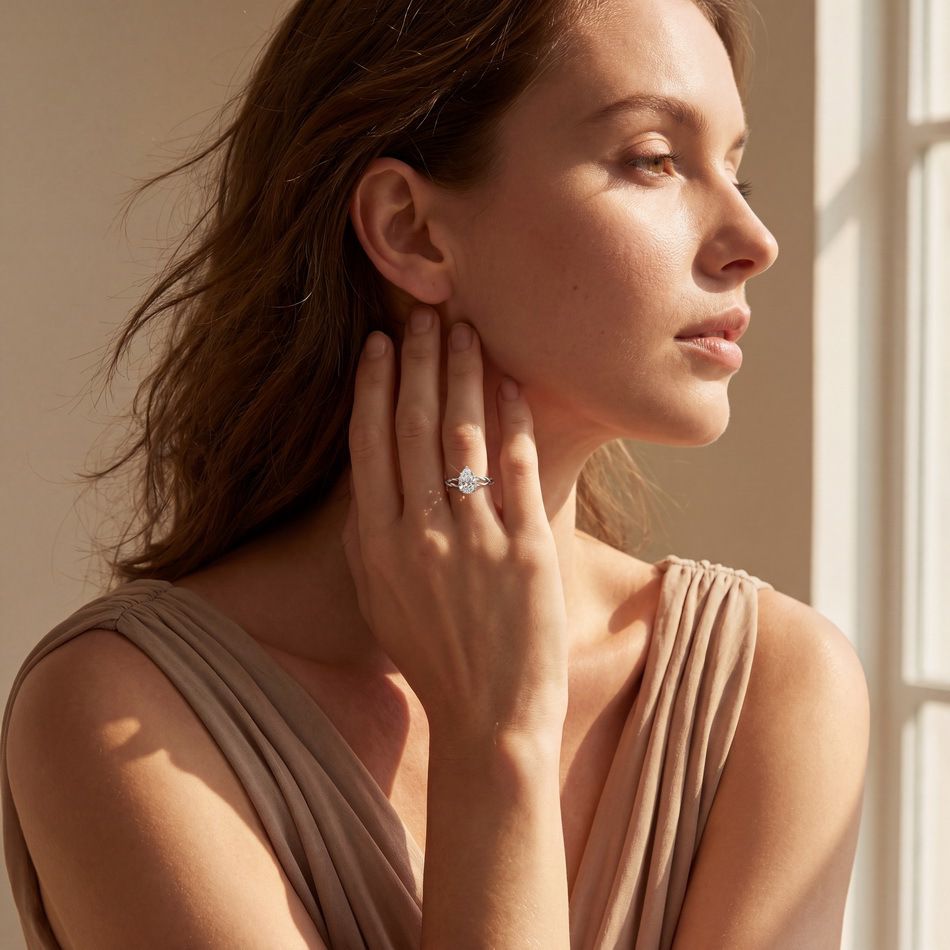
Wedding Rings & Bands
Polished vs. Brushed Wedding Band Finishes: What Lasts Longer?
Most couples pick their wedding band by metal, width, and profile, then stop there. But the finish on the band the surface texture decides how the ring ages, how often it needs attention, and how it looks on the hand after a few years of wear. The two most common choices are a high-polish finish and a brushed (also called matte) finish. They look and live very differently.
What a polished finish does
A polished band is buffed to a mirror shine. It is the classic look, the one that catches light and signals tradition. Polished gold or platinum looks radiant on the wedding day and photographs beautifully. It also pairs naturally with an engagement ring that already has bright prongs and a glossy halo, because the metals read as one continuous piece.
The downside is visibility. A mirror surface shows every fine scratch, every contact with a desk or a counter. Over time, a polished band develops a soft patina that many people love, but in the early years it can look worn faster than expected. The good news is that polishing is reversible. A jeweler can re-buff the band in minutes, and it looks new again. Just know that repeated polishing slowly removes tiny amounts of metal, so it is best done once a year, not monthly.
What a brushed finish does
A brushed band has a fine, linear texture cut into the surface with a wire wheel. It diffuses light instead of reflecting it, giving a soft, satin look. Brushed finishes have become the default for modern and men's bands because they read understated and sophisticated. The texture also hides small scratches remarkably well. A bump against a door frame barely shows on a brushed band, where it would stand out on a mirror finish.
Brushed does mean less sparkle, though. If you want a band that glints like your engagement ring, a fully brushed surface may feel quiet next to it. Many couples split the difference with a mixed finish: a brushed center flanked by polished edges, or a polished center rail with brushed sides. This gives the best of both, and it is a popular option in contemporary band profiles.
Finish and the rest of your jewelry
Think about the pieces your band will meet every morning. If you wear a polished engagement ring, a fully brushed wedding band can read as a mismatch in texture, even though the metal tone matches. A mixed-finish band bridges that gap, keeping a polished edge next to the ring while the brushed center faces the finger. If you wear a smart watch every day, a brushed band sits quietly beside it, while a high-polish band competes for shine. These small daily juxtapositions are worth considering before you choose.
Engraving and texture also interact. A deeply engraved pattern on a polished band catches light in a way that ages elegantly, while the same engraving on a brushed band disappears into the texture. Many couples who want a handwritten inscription on the outside choose polish so the letters stay legible over the years. Personalization ideas live in our engraved band guide.
Which finishes wear best by lifestyle
If you work with your hands, lift weights, garden, or type on a keyboard all day, a brushed finish will stay looking newer for longer. The texture absorbs the micro-scratches that a polished band collects. If you want a ring that shines and do not mind a yearly polish, choose high polish. For nurses, chefs, and hairstylists who rarely remove their rings, the brushed or mixed finish is the practical pick.
Metal choice interacts with the finish too. Platinum takes a brushed finish beautifully and develops a rich patina over decades. White gold holds a high polish well but will need rhodium touch-ups regardless of texture. Yellow gold softens nicely under either finish. Read more in our metal-by-climate guide if your local weather influences your choice.
Caring for each finish
Both finishes clean the same way: warm water, a drop of mild soap, and a soft brush. Avoid abrasive silver dips on either, because they can strip a brushed texture and dull a polished one. If a brushed band starts to look uneven, a jeweler can re-brush it to a uniform satin. If a polished band loses its luster, a quick re-polish restores the mirror. Neither finish is permanent damage waiting to happen; they are just different commitments to upkeep.
The bottom line
Polish for shine, tradition, and the willingness to polish once a year. Brush for a modern, low-maintenance surface that forgives daily wear. If you cannot decide, a mixed-finish band gives you the bright edge that matches your engagement ring and the durable texture where your finger rests. Whichever you choose, the finish is part of the ring's story, and it will tell that story for decades.
The history and conventions of engagement rings are outlined in the Wikipedia entry on engagement rings.
Frequently Asked Questions
What ring sizes can you supply in bulk?
US sizes 5–12 including half sizes. Send a size breakdown with your order and we cast to that curve; comfort-fit inner bands reduce resize requests.
Can I order a mixed size run instead of one size?
Yes. Mixed runs are standard for wholesale: specify quantity per size and we pack and label by size at no extra labor cost.
What is the MOQ for custom ring designs?
50 pieces per design for existing molds; 100–300 pieces when a new mold or CAD model is required.
How should I price rings for retail margin?
Most partners use a 3–4x markup on FOB cost for sterling and 2.5–3x for moissanite solos, which keeps landed cost under 30% of retail.
Send your spec sheet — stone, cut, size, plating and quantity — and we will return a costed timeline.
Ask the workshop