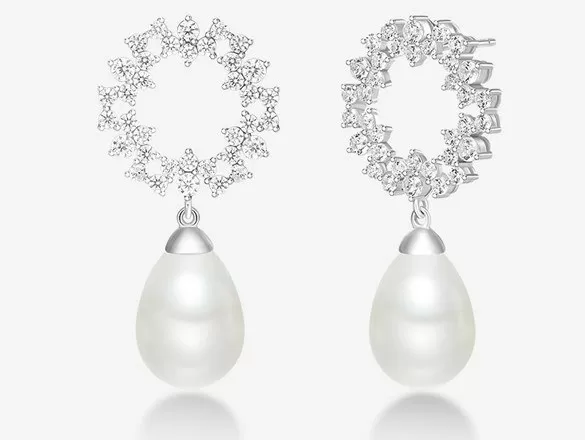
Earrings
Moissanite Stud Earrings for the Wedding Day: Size, Setting, Hair
A bridal makeup artist told us she sees the same mistake every weekend: brides wear tiny 3mm studs on the wedding day, and in every photo the earrings vanish against a veil and a white gown. The ear is one of the few exposed points in a ceremony portrait, so the stud choice is actually a styling decision, not a jewelry afterthought.
Size: what reads in photos
Stud sizing is measured in stone diameter, not carats. A 5mm stud equals roughly a 0.5-carat diamond look per ear; a 6.5mm stud reads like 0.9 carats; an 8mm stud reads like 1.25 carats. For a wedding with an updo and bare neckline, 6-7mm is the sweet spot: visible without overpowering. For hair-down styles or strapless gowns, 7-8mm carries better in natural light. If you wear the studs again for work, 5-6mm is more versatile after the wedding. The sparkle engine behind the stone is the same optical physics as a diamond, and Wikipedia: Diamond explains why a well-cut round returns light to the eye.
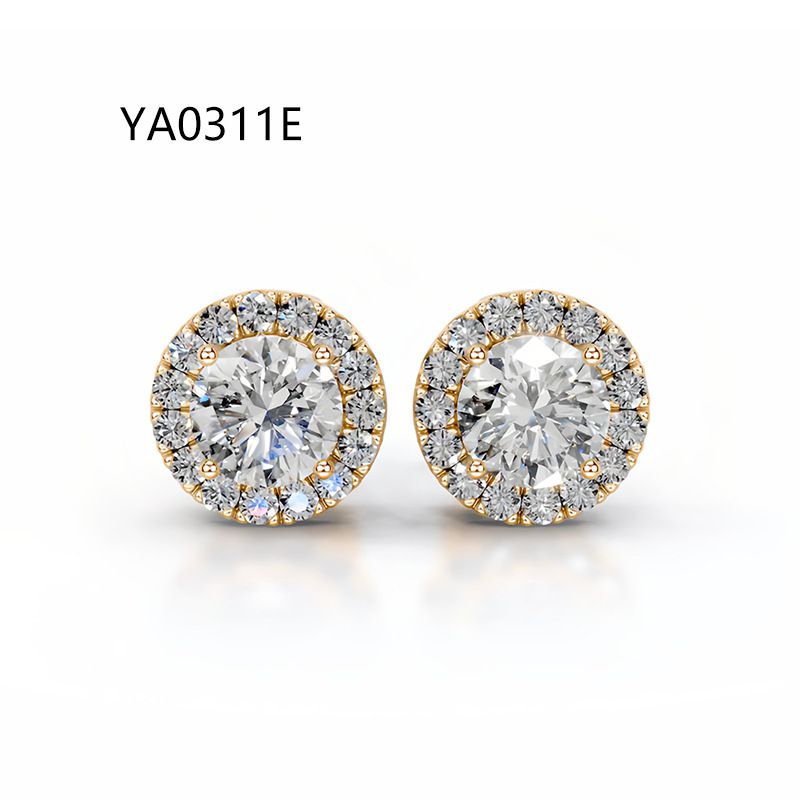
Setting: basket, bezel, and backs
A basket setting holds the stone with prongs above an open base, letting light in from below and giving the brightest sparkle. A bezel wraps metal around the stone and is the safest for active brides and for brides who never remove their jewelry. For backs, choose screw-backs on the wedding day; push-backs slip off during veils, hugs, and airport security, and we have replaced more lost push-back studs than we can count. Metal choice: 14k white gold or platinum matches a white-metal engagement ring; yellow gold studs add warmth under cool lighting. Compare metals in wedding band metals.
Hair, neckline, and the rest of the set
An updo shows the whole stud, so a slightly larger stone works. Hair-down hides the earlobe, so choose a stone on the larger side or a drop below the lobe. Pair studs with a tennis bracelet if you want a coordinated bridal moment; tennis bracelets as a bridal gift covers sizing. Avoid competing necklaces: with studs, a short pendant or bare neck reads cleaner in photos than a high necklace that crowds the jawline. If your center stone is moissanite, match its color grade so the earrings do not look warmer than the ring; background in moissanite engagement rings guide.
Wear them in, before the wedding
New studs in new ears mean redness on day one. Wear the studs for at least three short outings before the wedding so your ears are settled. Bring them with you to the final hair trial; the stylist will tell you whether the updo leaves enough ear exposed to justify the size you picked. If your ears are sensitive, swap the posts for platinum before the big day; nickel reactions show up fastest on stressed skin.
Metal and allergies
Cheap stud posts are often nickel alloyed, and nickel is the most common earlobe allergen. If your ears have ever reacted to costume jewelry, choose 14k gold or platinum posts. Sterling silver posts are usually safe but tarnish and need polishing. Plated posts wear off in months and expose the base metal underneath. For a wedding day, skip the plated option; the $30 difference is not worth a red earlobe in photos.
Storing and traveling
Studs travel best in a hard clamshell case, not loose in a jewelry roll where the prongs scratch. Pack the backs on separately in a small bag; backs sitting on the stones in transit chip the girdle. On the wedding morning, put the studs on last, after makeup and hairspray, because hairspray films the stone and dulls the fire within hours. Clean them with a soft cloth after the reception.
FAQ
Do moissanite studs look different from diamond studs?
Up close, moissanite throws slightly more rainbow fire than a diamond. At photo distance, arm's length to a camera, they read the same. The color grade (D-F) is what keeps them from looking tinted.
What carat total weight should wedding studs be?
Plan for 1.0-1.8 carats total weight (both ears combined) for a wedding-day look. That translates to 5-7mm stones per ear. Heavier wrists and larger ears can carry 2ctw.
Should studs match my engagement ring exactly?
Color temperature should match (both cool D-F, or both warm G-H), but the setting does not need to match. A plain basket stud next to a halo ring is a classic, not a mismatch.
Can I wear moissanite studs every day after the wedding?
Yes. At Mohs 9.25, moissanite handles daily wear; the earlobe does no mechanical work, so the studs outlast almost any other jewelry you own. Clean monthly with warm soapy water.
Bridal CTA: HOLYCOME moissanite stud earrings ship as a paired set in 14k white gold with screw-backs and a graded D-color stone per ear. Try them for 30 days; pair them with a tennis bracelet and save on a full bridal accessory set.
Frequently Asked Questions
Is moissanite a good diamond alternative for retail buyers?
Yes for price-sensitive customers who want brilliance and hardness. Moissanite ranks 9.25 on the Mohs scale, holds up to daily wear and costs a fraction of a natural diamond of the same size, so it resells fast in bridal and fashion lines.
What is the minimum order for wholesale moissanite?
MOQ starts at 50 pieces per design for stock items. Custom cuts and private-label settings usually start at 100–300 pieces depending on the mold.
Do you provide certificates with moissanite stones?
Yes. Every parcel ships with GRA or IGI documentation listing carat weight, color grade and cut. We recommend passing the certificate to your end customer for trust.
How long does sample and bulk production take?
Samples ship in 3–5 days. Bulk runs take 15–20 days under 500 pieces, and 25–30 days for custom work.
Send your spec sheet — stone, cut, size, plating and quantity — and we will return a costed timeline.
Ask the workshop