Wedding Rings & Bands
Curved & Contour Wedding Bands for Irregular Engagement Rings
One of the most common fitting problems a bridal jeweler solves is simple: the engagement ring is not a clean circle, and the straight wedding band leaves a visible gap next to it. The fix is not to force the straight band and hope. The fix is a curved, contour, chevron, or notched wedding band shaped to nest against the exact setting. Once a couple sees the two rings sitting flush, the difference is obvious.
Why a straight band often does not work
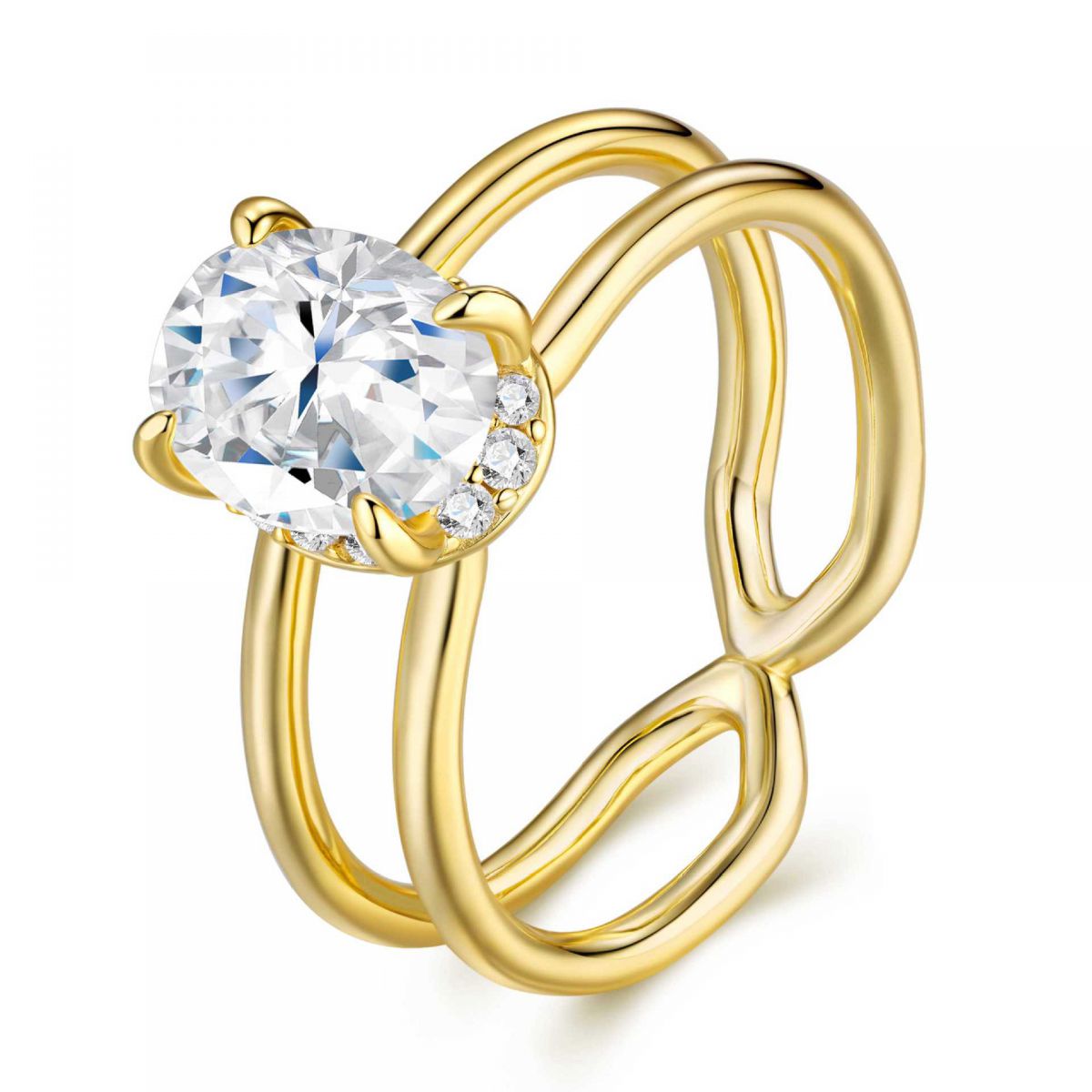
A solitaire with a plain round shank is the easy case—a straight band sits tight against it. The trouble starts when the setting has volume. A halo with stones running down the shoulders, a three-stone ring with raised side stones, a vintage design with cut-outs, or a twisted organic shank all create bumps and gaps. Push a straight band against these and it rocks, leaves a shadow gap, or crowds the stones. A contour band is built to match the negative space.
The main shapes brides will hear about
A curved or contour band has a gentle inward swoop that follows the lower edge of the engagement ring. A chevron or V band points toward the fingertip and pairs especially well with pear, marquise, or three-stone rings. A notched or nested band has a small cut-out that clears a specific bump, like a bezel or a basket corner. A shadow band sits low and slim, hugging the underside of a higher setting. Knowing these names lets you match the right band to the ring rather than guessing.
How to get the contour right
A true contour band is usually made to fit a specific engagement ring, not pulled off the shelf. That means measuring the ring's profile and ordering or custom-forming the band to match. If the engagement ring is a stock halo, many suppliers offer a matching curved band made for that exact design. When the setting is one-of-a-kind, the band may need to be custom-formed to nest properly. Plan the lead time so the band is ready before the wedding.
When a straight band is still the right call
Not every couple wants a perfect flush. Some deliberately wear a straight slim band for contrast, or plan to wear the engagement ring alone on the wedding day and stack later. Others love the modern look of two offset rings. Present both options. The goal is for the couple to choose the gap on purpose rather than end up with one by accident.
Stacking beyond the contour band
Once the contour band solves the fit, many brides want a third, thinner band stacked for texture. That opens a conversation about stackable wedding bands and anniversary gifts. It also raises practical points—total width on the finger, finger size once three rings are stacked, and how the stack affects resizing later. Cover those early so the stack stays comfortable for decades, not just for the photos.
The takeaway
A contour band turns a frustrating gap into a tailored, intentional look. When a bride shows you an irregular engagement ring, the first question is not "what band do you like?" but "what shape does your ring leave?" Answer that and the rest follows.
To solder or not to solder
Once two rings nest perfectly, couples often ask whether to solder them together. Soldering locks the contour band in place so it never rotates or shifts, and many brides love that security. The trade-off is flexibility: a soldered stack cannot be worn apart, and resizing later means undoing the join. If the bride wants to mix and match, keep them separate. If she wants a flawless, no-gap look on the wedding day and plans to wear the pair forever as one, soldering is worth discussing. We cover the full trade-off in our guide to soldering wedding bands.
A quick checklist before ordering
Measure the engagement ring's profile precisely—the height of the setting and the shape of the gap. Confirm the couple will wear the rings together on the same finger, not one on each hand. Ask whether they want a flush fit or are happy with a deliberate contrast. And always build in lead time, because a true custom contour band is made to the ring, not pulled off a peg. Get these four details right and the fit on the wedding day will be seamless.
What it costs and why it is worth it
A contour band usually costs a bit more off the shelf than a straight band, because it is shaped to a specific ring rather than a universal size. But that premium buys a look that cannot be improvised—two rings sitting as one, with no awkward shadow gap to distract from the stone. For a bride who has dreamed of the perfect set, the extra step is rarely regretted. It turns a good pairing into a tailored one, and that is the difference between a ring she likes and a ring she cannot stop looking at on her hand.
The history and conventions of engagement rings are outlined in the Wikipedia entry on engagement rings.
Frequently Asked Questions
What ring sizes can you supply in bulk?
US sizes 5–12 including half sizes. Send a size breakdown with your order and we cast to that curve; comfort-fit inner bands reduce resize requests.
Can I order a mixed size run instead of one size?
Yes. Mixed runs are standard for wholesale: specify quantity per size and we pack and label by size at no extra labor cost.
What is the MOQ for custom ring designs?
50 pieces per design for existing molds; 100–300 pieces when a new mold or CAD model is required.
How should I price rings for retail margin?
Most partners use a 3–4x markup on FOB cost for sterling and 2.5–3x for moissanite solos, which keeps landed cost under 30% of retail.
Send your spec sheet — stone, cut, size, plating and quantity — and we will return a costed timeline.
Ask the workshop