Bracelets & Bangles
Bulk Moissanite Tennis Bracelets: Wholesale Sourcing
A bridal buyer in Toronto ordered 60 moissanite tennis bracelets to layer with her ring case, and within six months ten came back with a popped clasp and five with dulled plating. The bracelets were cheap at cost, but the return and replacement freight erased the margin. A tennis bracelet is a setting machine: twenty to forty stones in a single flexing row, and the clasp and links take more abuse than any ring. Sourcing (FTC jewelry industry guides) them in bulk means specifying the parts that flex, not just counting carats. Below is the spec we build to, the failure points buyers miss, and the price tiers that sell through in a bridal case.
Where tennis bracelets fail first
Of the returns we see in this category, clasp failure leads by a wide margin, followed by plating wear on the high-friction underside of the wrist. Stone loss is third, but it is the most visible. The table below shows the typical weak points against how we build.
The reason tennis bracelets fail more often than rings is mechanical. A ring sits on a finger and barely moves. A bracelet flexes thousands of times a day with every wrist turn, and every flex loads the links and the clasp. A component that survives a static ring setting will fatigue on a flexing band within months, which is why the spec has to be built around movement, not around how the piece looks on a velvet pad.
| Failure point | Budget bracelet | Our build spec |
|---|---|---|
| Clasp | Single-box, no safety | Box clasp with figure-8 safety, pull-tested to 2.5kg |
| Plating | 0.3 micrometre rhodium | 0.5 micrometre rhodium |
| Links | Stamped, thin | Cast links with closed backs |
| Stone seat | Glued | Four-prong seat per stone |
The spec behind the spec
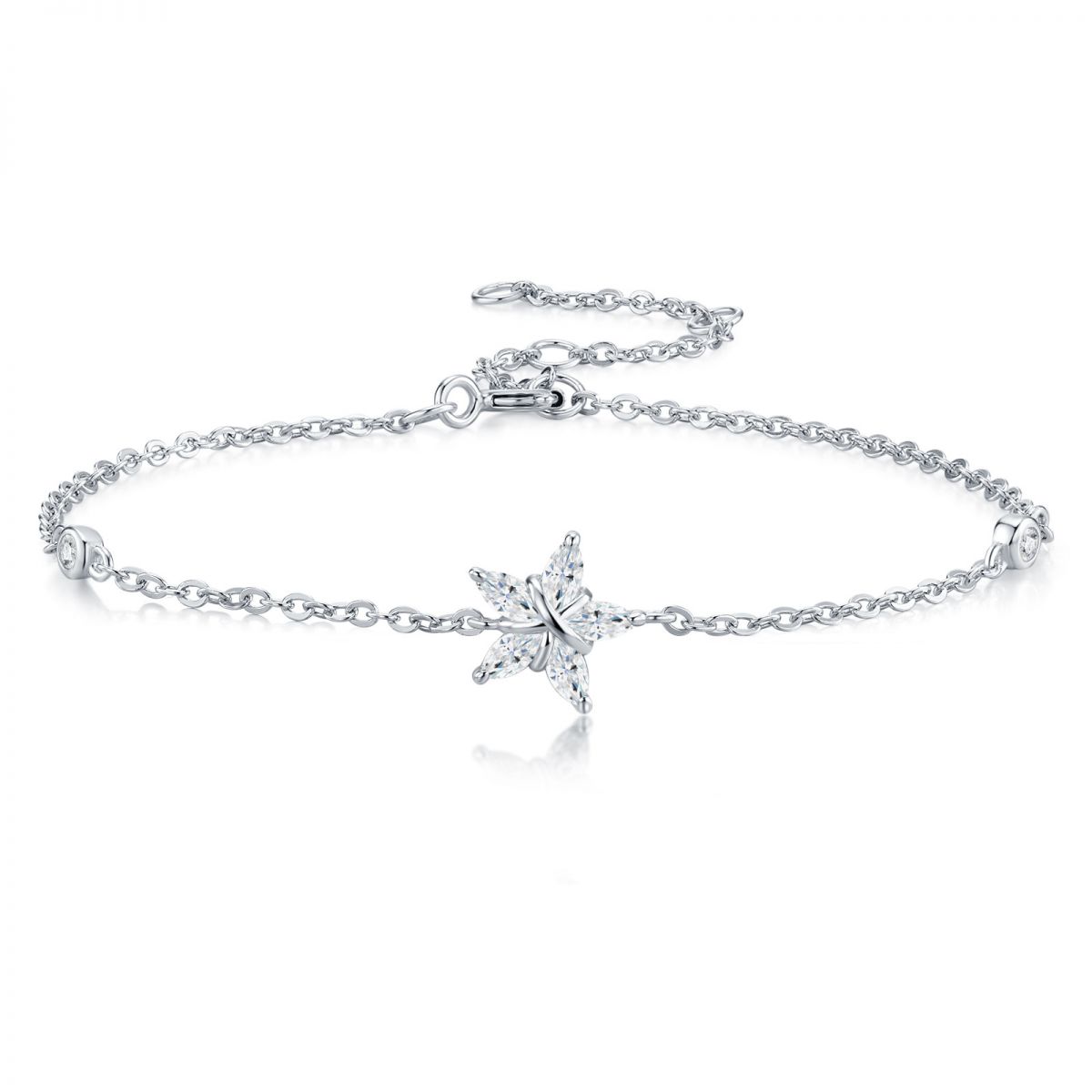
Our best-selling bulk tennis bracelet uses 3mm round brilliant moissanite in a single row, roughly 8 to 9 carats total equivalent on a standard 18cm wrist. The stones are set in four-prong seats rather than glued, because glue fails on a flexing band within a year. The clasp is a box clasp with a figure-8 safety catch, pull-tested to 2.5 kilograms at QC, which is well above the 1kg visual check most budget factories apply. The chain includes a 2cm extension so the bracelet fits 16 to 19cm wrists without a separate sizing job in store.
On plating, we run 0.5 micrometre rhodium over 925 sterling silver. At that thickness the white finish holds roughly 40% longer under daily wear than the 0.3 micrometre plate common in budget imports, which matters because a yellowing tennis bracelet reads as cheap on a wrist next to a brand-new bridal set. Each stone is eye-clean and matched for color across the row, so the bracelet reads as one continuous line of light rather than a stack of mismatched points.
How to buy by store type
A bridal boutique opening a side-case should start with the 3mm single-row bracelet in silver, because it layers under an engagement ring and sells as a push gift or anniversary add-on. A high-end store can step up to a 4mm row or a two-tone version for a higher ticket. A private-label brand should ask about co-branded boxes and a laser-engraved serial on the clasp, which lifts perceived value without raising unit cost much. On depth, stock 18cm as the core length with a few 16cm and 19cm units; the extension chain handles the rest.
When you reorder, keep the first batch small and watch which clasp style moves. The box-with-safety clasp is the default across our range, but if your customer base buys heavily as gifts for younger buyers, a simpler fold-over clasp may read as more modern. That is a taste call the first batch will tell you, and it is the kind of feedback that lets us build the next run to your store rather than to a generic spec.
Frequently Asked Questions
What carat size sells best in a tennis bracelet?
A single row of 3mm stones, roughly 8 to 9 carat equivalent, is the strongest seller for bridal and everyday wear. It reads as dressy without competing with the engagement ring on the same hand.
How do I prevent clasp returns?
Spec a box clasp with a figure-8 safety catch and a pull-test rating of at least 2.5kg. The single-box clasp without safety is the component that fails first on budget imports.
What wrist sizes should I stock?
Stock the 18cm core length with a 2cm extension, which covers 16 to 19cm wrists. Add a few 16cm units for slender wrists instead of buying a full size range.
Is rhodium plating on silver enough for daily wear?
At 0.5 micrometre it is. Thinner 0.3 micrometre plate dulls within months on the high-friction underside; the thicker plating resists that and holds the white finish.
Can tennis bracelets be engraved or private-labeled?
Yes. We laser-engrave a serial on the clasp and can co-brand the outer box for private-label runs above the standard MOQ, typically 30 pieces per design.
Takeaways
- Spec a box clasp with safety catch and a 2.5kg pull test.
- Buy 0.5 micrometre rhodium, not the 0.3 budget plate.
- Four-prong stone seats outlast glued settings on a flexing band.
- Stock the 18cm length with extension; skip the full size range.
Browse moissanite tennis bracelets, pair with bridal sets, and read more in our bracelet sourcing guide. New buyers can order a sample bracelet to test the clasp in hand.
The 92.5% silver composition and properties of sterling silver are described in the Wikipedia entry on sterling silver.
Send your spec sheet — stone, cut, size, plating and quantity — and we will return a costed timeline.
Ask the workshop