"Profile" is one of those jewelry words that shoppers never use, but it quietly determines how a wedding ring looks on the hand, how it stacks against an engagement ring, and whether a customer leaves your store loving the piece or quietly planning an exchange. For an independent US jeweler, being able to explain profile in plain English is one of the fastest ways to look like an expert and to justify a price ladder across otherwise similar-looking bands.
GemWSL manufactures the major wedding band profiles in 925 sterling silver, with optional moissanite accents, for retailers across the United States. This guide breaks down the three profiles your customers will actually encounter—flat, rounded (court), and pipe-cut—plus a few modern variants, and explains how to match them to engagement rings and merchandising decisions.
What "Profile" Actually Means
Profile is the cross-sectional shape of the band when you slice it across the finger. It is not the width, not the finish, and not the stone setting. Two bands of the same width and same finish can feel completely different on the finger if their profiles differ. The profile controls how much metal touches the skin, how rounded the outer edge looks, and how the band sits next to an engagement ring.
Sales teams that can visualize the cross-section sell better, because they can answer the two questions every bride asks: "will this sit flush next to my engagement ring?" and "will this feel comfortable all day?" Both questions are really profile questions.
Flat (Bench-Made) Profile
A flat profile band has a flat outer surface and a flat or very slightly eased inner surface. The sides run nearly vertical, so the band looks like a narrow wall standing up on the finger. This is the classic "bench-made" look, associated with hand-forged and Art Deco styles.
Visually, flat profiles read as modern, architectural, and gender-neutral. They are particularly popular with brides who want a thin, graphic band that stacks cleanly under a solitaire, because the flat top sits flush against the engagement ring's shank. They are also the default choice for engraved bands, because the flat outer face provides a clean, even surface for lettering.
The trade-off is comfort. A flat-profile band with vertical edges can feel sharp against the finger, especially in widths over 4mm. Most flat-profile bands sold today are slightly eased on the outer edges to soften that feel, but they still do not match the all-day comfort of a rounded profile.
Rounded (Court / Comfort-Fit) Profile
A rounded profile, also called a court profile, has a gently domed outer surface. The sides curve up from the finger to a soft peak, rather than running straight. This is the profile that most people picture as a "traditional" wedding ring, and it is the profile used on nearly all comfort-fit men's bands.
Rounded profiles look substantial and premium, because the dome catches light from more angles. They also feel smooth on the finger, with no sharp edges. The downside for stacking: because the outer surface is curved, a rounded band sits slightly higher next to a flat-shanked engagement ring, which can create a tiny gap. For most customers that gap is invisible, but for a bride obsessed with a flush fit, a flat profile is the safer call.
Rounded profiles are the strongest sellers in widths 5mm and above, particularly in men's rings, and they photograph beautifully in wedding-day close-ups.
Pipe-Cut (Half-Round) Profile
A pipe-cut profile is essentially a half-round: the outer surface is fully domed, and the inner surface is flat. It is the profile you get when you slice a length of round tubing in half, which is where the name comes from. Pipe-cut bands are thinner and lighter than full comfort-fit bands, because they use less metal.
Pipe-cut is the sweet spot for thin women's bands, typically 2mm to 3mm. It looks delicate on the hand, wears lightly, and prices lower than a full rounded band, which makes it a strong entry price point. It also stacks very cleanly under engagement rings, because the flat interior sits against the skin and the half-round outer face sits flush with the adjacent ring. For a bride building a stack of multiple thin bands, pipe-cut is the profile that makes the stack look intentional rather than bulky.
Other Profiles Worth Knowing
Beyond the big three, you will occasionally encounter a concave (hollowed-out outer surface), a beveled (flat top with chamfered edges), and a hammered or matte-textured variant. These are fashion profiles, not bridal staples, and they sell to a smaller, more design-driven customer. We recommend carrying one or two in each finish rather than building a wall around them.
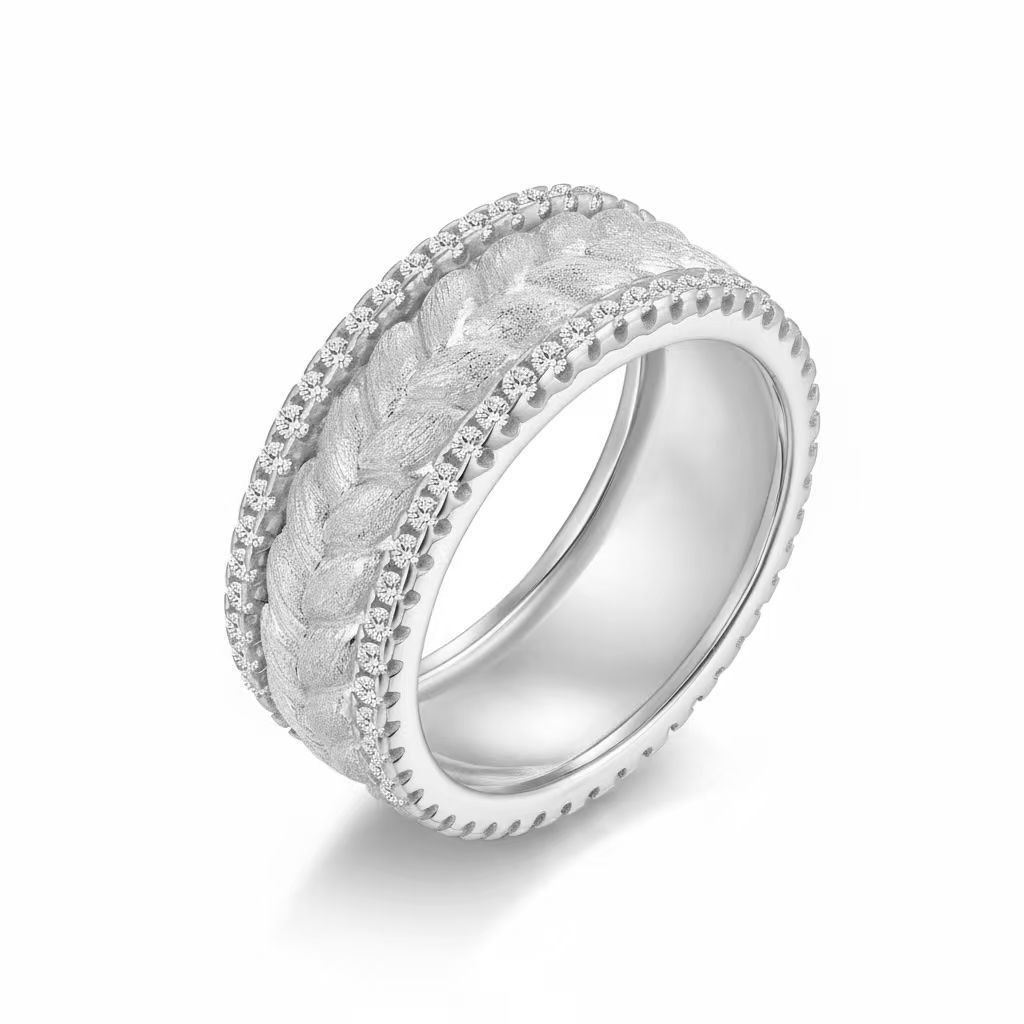
Moissanite settings also interact with profile. A channel-set row of stones on a flat profile looks graphic and modern; the same row on a rounded profile looks softer and more classic. When you stock a moissanite-accented band, be intentional about which profile you choose, because the stone setting and the profile read as one visual.
Matching Profile to Engagement Ring Style
The single most useful question a sales associate can ask is, "what does your engagement ring shank look like?" If the engagement ring has a flat shank (common in solitaire and cathedral settings), a flat or pipe-cut wedding band will sit flush. If the engagement ring has a rounded shank (common in vintage-style and pave settings), a rounded wedding band will mirror that curve and look like a matched set.
When a bride has a cathedral or raised setting, a contoured (notched) band is sometimes needed to fit underneath. That is a custom or semi-custom conversation, and it is where OEM production from a factory-direct partner pays off: GemWSL can produce contoured bands to match a specific engagement ring profile, rather than forcing the customer to compromise on a straight band that does not sit right.
Retail Display and Upselling
Profile is a perfect upsell lever because the cost difference is small and the perceived difference is large. A customer trying on a plain 6mm flat band can be shown the same width in a rounded comfort-fit and immediately feels the premium. That comparison closes more sales than any price sign. We recommend keeping three identical-width bands—flat, rounded, pipe-cut—on a display truss, so customers can feel the difference in their own hands.
Train your staff to describe profile without jargon. "This one sits flat and modern. This one feels rounded and traditional. This one is light and thin, perfect for stacking." That is enough to guide the decision without the customer feeling lectured.
Closing: Profile Is the Detail Your Customers Feel
Most shoppers cannot tell you the karat weight or the plating thickness of their wedding band, but they will absolutely feel whether it digs into their finger, sits flush against their engagement ring, or looks modern versus traditional. That feeling is almost entirely profile. By stocking flat, rounded, and pipe-cut profiles in the same widths and finishes, and by training your team to describe the difference in plain language, you turn a wall of bands into a guided consultation. GemWSL produces all three profiles in 925 sterling silver, with rhodium, vermeil, and optional moissanite accents, ready for private-label shipment to your store.