For independent US jewelers and bridal boutiques, the shape of a loose moissanite stone drives almost every downstream decision: the setting style, the perceived carat size, the price per carat they can charge, and the customer walking through the door asking for "something that looks like a two-carat round." As a factory-direct wholesaler shipping out of Wuzhou, China, we stock all major moissanite shapes, and the questions we hear most often from new buyers are which shapes actually sell, how they compare on face-up size, and which cuts are safest to set. This guide breaks down the five core moissanite shapes your counter should carry.
Why shape matters more than carat in moissanite retail
Unlike mined diamonds, where a GIA carat report anchors the price conversation, moissanite is sold almost entirely on appearance. A 6.5 mm round moissanite is marketed as a 1.0 carat equivalent, but an oval of the same actual weight can look materially larger on the finger because its elongated face-up surface spreads light across more skin. American bridal shoppers are increasingly value-literate: they want the halo look, the finger coverage, and the sparkle, without the diamond invoice. Understanding shape-to-face-up ratios lets you buy parcels intelligently and price finished rings with confidence.
Round brilliant moissanite
The round brilliant remains the volume engine of the category. It is the shape most customers picture when they say "engagement ring," and it is the easiest for your bench jeweler to set in a solitaire, halo or six-prong mounting. Round moissanite is cut to maximize brilliance, which is where moissanite genuinely outperforms diamond: its refractive index produces more fire and dispersion, and a well-cut 6.5 mm round reads as brighter than many equivalent mined stones.
- Face-up size: Standard 6.5 mm equals the 1.0 ct round diamond benchmark; 8.0 mm equals 2.0 ct.
- Setting ease: Highest. Universal prongs, compatible with every off-the-shelf solitaire.
- Retail demand: ~55-65% of moissanite engagement ring sales in the US market.
- Watch-outs: Lower grades can show a grayish body tone under office fluorescent light; buy D color VVS for round stock.
Oval moissanite
Oval is the fastest-growing shape in our export shipments. Customers love how it lengthens the finger, and wholesalers love that ovals command a slight per-carat premium over rounds because they feel more distinctive. A 7x9 mm oval moissanite covers roughly the same skin area as a 1.5 carat round while weighing less actual carat.
- Face-up size: ~1.2-1.3x the finger coverage of an equivalent round.
- Setting ease: High, but avoid very thin stones; look for a proper bow-tie that is not exaggerated.
- Retail demand: Second after round, especially among younger, design-led brides.
- Watch-outs: A poorly proportioned oval shows an ugly dark bow-tie across the center; inspect face-up before bulk ordering.
Pear and marquise moissanite
The pear cut combines the softness of an oval with a tapered point that reads elegant and vintage. It is a strong choice for customers who want something recognizable but not mainstream. Pears photograph beautifully in engagement ring marketing, which is why Instagram-driven boutiques over-index on this shape. Marquise is thinner at the tips and chips more easily, so we recommend ordering slightly oversized stones and having the bench round the girdle during setting.
- Face-up size: Among the largest per actual carat; pears elongate the finger dramatically.
- Setting ease: Medium. Tips require protective V-prongs or bead seats to prevent chipping.
- Retail demand: Niche but loyal; strong in vintage and art-deco themed collections.
Emerald cut moissanite
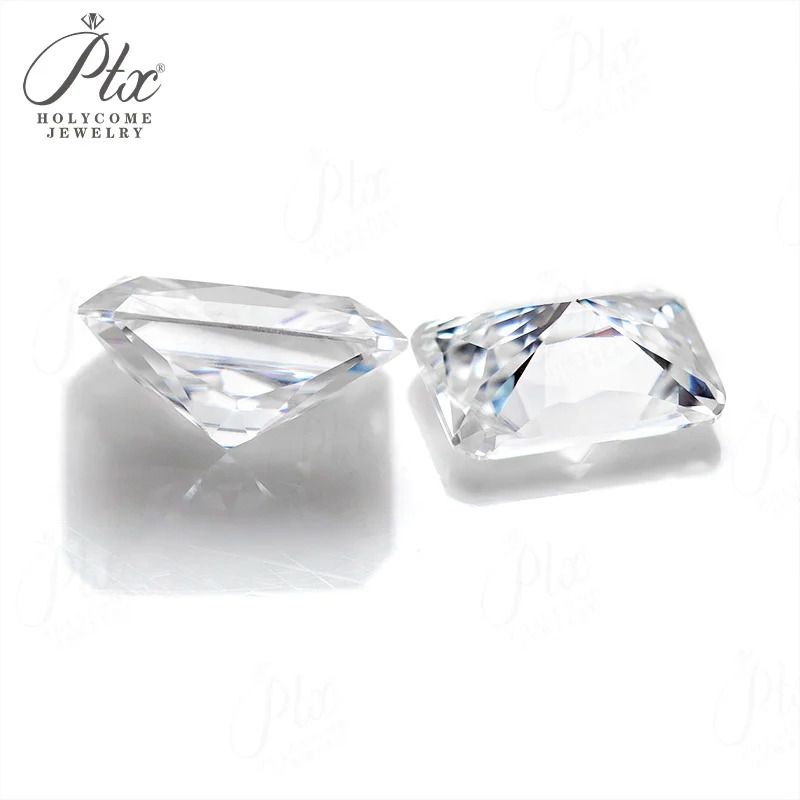
Emerald cuts trade sparkle for clarity of line. Their step-cut facets emphasize the stone's transparency, table size and long, linear reflections rather than fiery scintillation. This is the shape that most reliably reads as "quiet luxury" and that pairs naturally with a platinum or 14K gold shared-prong setting. Because step cuts hide inclusions less well than brilliants, emerald moissanite stock should always be ordered in VVS or higher.
- Face-up size: Wide table gives excellent finger coverage.
- Setting ease: High; the open corners are usually protected by four corner prongs.
- Retail demand: Growing steadily, especially among corporate and professional buyers.
- Watch-outs: Any visible inclusion or gray cast is immediately obvious in a step cut — do not skimp on grade.
Princess cut moissanite
The princess cut — a square brilliant with pointed corners — sits between round sparkle and modern geometry. It tends to be priced lower per carat than rounds because customers perceive it as "less classic," which makes it an attractive margin item for retailers. It is also the shape most often chosen for right-hand fashion rings and wedding band stacking sets.
- Face-up size: Square footprint is compact but dense.
- Setting ease: Medium. The four sharp corners must be fully protected or they will chip under stress.
- Retail demand: Steady; popular in men's signet rings and unisex designs.
Cushion and other fast-growing shapes
While the five core shapes anchor most orders, cushion moissanite has quietly become the third shape in many US bridal cases. A cushion cut softens the corners of a square stone into a rounded outline, blending round-style brilliance with a vintage look. It is the shape customers describe as "art-deco but modern," and it pairs naturally with a halo of melee. If your case already carries round and oval stock, adding two or three cushion stones in 6.5-7.0 mm is the lowest-risk way to test a new shape. Hexagonal, asscher and heart cuts exist in wholesale parcels but move much more slowly; we recommend stocking them only to order.
Building a balanced shape inventory
New buyers often ask whether they should invest heavily in the trending shape of the season. Our recommendation is to anchor roughly 60% of loose moissanite spend in round, 20% in oval, and split the remaining 20% between pear, emerald and princess. Rounds and ovals keep the register moving; the other three shapes let you differentiate your case and upsell customers who already saw a round on Instagram. Always order a single sample stone of each shape before committing to a parcel, and inspect it under both daylight and a cool white office lamp.
Final buying checklist
- Confirm exact mm dimensions, not just carat equivalent.
- Request face-up photos of ovals and pears to check bow-tie and symmetry.
- Order D color VVS for step cuts and rounds; near-colorless is acceptable for fashion shapes.
- Verify prong compatibility with your existing mounting line before bulk shipping.
With a balanced shape mix and a reliable factory partner, your store can offer a full bridal menu at a price point that competes directly with lab-grown diamond retailing. Contact GemWSL for current shape stock lists, sample stones and wholesale parcel pricing tailored to your case.