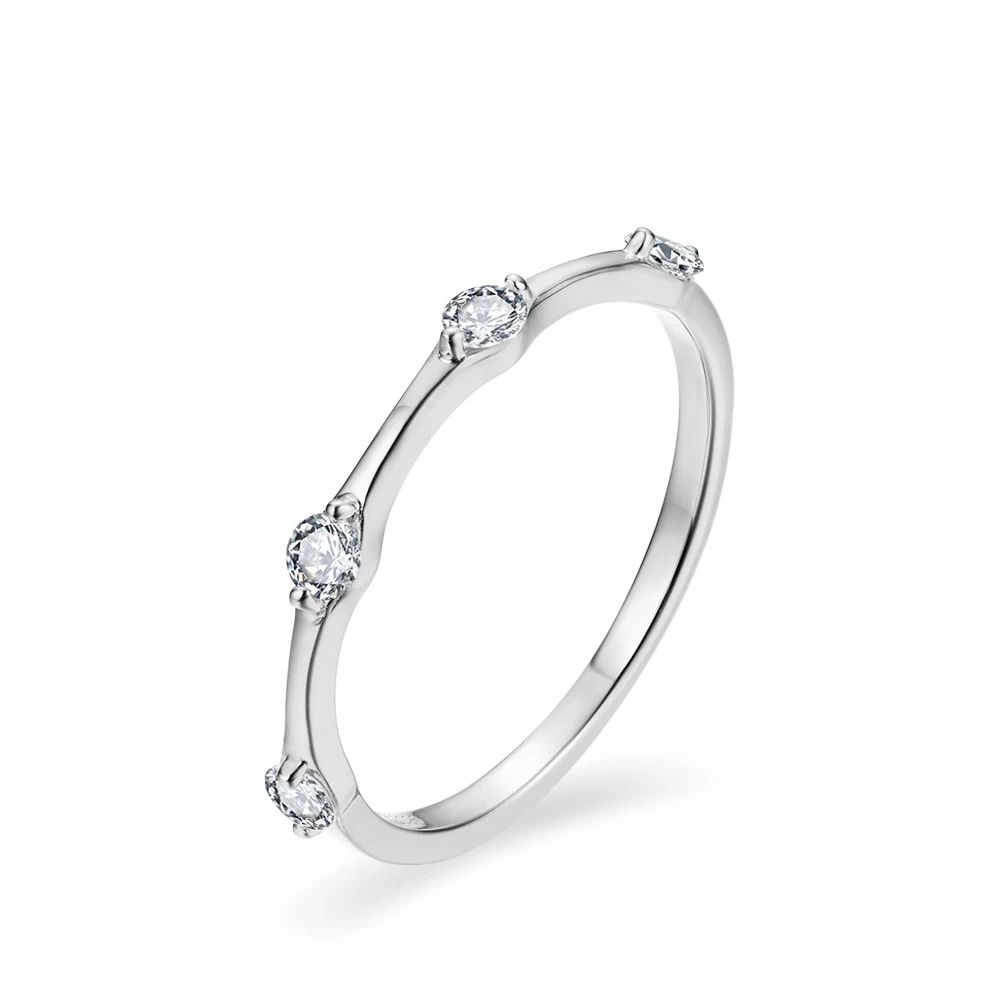
One of the most common questions from new US retailers is: 'Why is one wholesale moissanite engagement ring $25 and another $85, when both look like the same 6.5 mm stone?' The answer is that moissanite engagement rings are not a single product. They span three distinct pricing tiers, each with different stone quality, setting complexity, plating thickness, and certificate documentation. This guide maps those tiers to factory-direct pricing from Wuzhou and explains how to mark them up for healthy retail margin.
The Three Wholesale Pricing Tiers
For most US retailers buying moissanite engagement rings from Wuzhou factories, the market breaks into three tiers. The exact dollar figures shift over time, but the relative structure is stable.
Tier 1 — Entry Tier
Typical wholesale range: $15–$35 per ring (6.5 mm center, silver setting).
- Moissanite of commercial grade, often with slight inclusions or a visible tint.
- 925 silver setting, basic rhodium plating (thin, 0.05–0.1 micron).
- No GRA certificate, or a generic certificate.
- Simple solitaire or basic halo settings.
Who it serves: Online boutiques selling under $99, fashion-jewelry adjacent brands, and gift or proposal-package SKUs. Risk: Thin plating tarnishes within months, and customers may return the ring as 'not real.'
Tier 2 — Mid Tier
Typical wholesale range: $35–$70 per ring.
- Commercial-white or near-colorless moissanite, typically GRA-certified.
- Solid 925 silver, rhodium plating 0.2–0.5 micron.
- GRA certificate included with each center stone.
- Solitaire, halo, three-stone, and simple vintage settings.
Who it serves: The bulk of independent US bridal retailers. This is the sweet spot for most boutiques and small jewelers. Risk: Lowest. Mid-tier rings are what most customers expect when they pay $150–$350 retail.
Tier 3 — Premium Tier
Typical wholesale range: $70–$150+ per ring.
- Premium colorless moissanite (Forever-One equivalent grade), with higher clarity and tighter color.
- Thicker rhodium or 18K vermeil plating (1–2 microns).
- GRA certificate with full grading parameters.
- Complex settings: double halo, vintage filigree, pavé shanks, art-deco layouts.
Who it serves: Showroom jewelers, online brands positioning as 'fine jewelry alternatives,' and customers who would otherwise be comparing to $2,000+ diamond rings.
What Actually Drives the Cost Difference
When you compare quotes from Wuzhou suppliers, the price difference comes from four variables, not from 'brand' or 'quality mystique.'
- Moissanite color grade. D-F colorless moissanite costs roughly 30%–60% more than commercial-grade. The difference is visible only under side-by-side comparison, but premium customers will notice.
- Plating thickness. A 2-micron rhodium plating costs roughly twice as much as a 0.1-micron plating but lasts 5–10x longer.
- Setting complexity. A double halo or pavé shank uses 30–80 accent stones and takes 3–5x longer to set than a solitaire.
- Certification. GRA certificates cost per unit and require the stone to be graded before setting. Entry-tier suppliers skip this entirely.
How to Set Retail Markup by Tier
The temptation for new retailers is to apply the same multiple across all tiers. That is a mistake. Each tier serves a different customer and should be marked up differently.
- Tier 1: 2.5x–3x wholesale. Entry-tier customers are price-sensitive and comparison-shopping. A $25 wholesale ring retails at $65–$79. Do not try to mark this up like premium jewelry.
- Tier 2: 3x–3.5x wholesale. The standard. A $50 mid-tier ring retails at $150–$175. This is the price point where most US bridal customers make a decision without extended negotiation.
- Tier 3: 3.5x–5x wholesale. Premium customers are comparing to diamond rings that cost $2,000–$5,000. A $100 premium ring retails at $350–$500 and still looks like a fraction of the diamond alternative.
Avoid the Most Common Pricing Mistake
The most common mistake is buying Tier 2 cost but pricing like Tier 1. A retailer buys a $50 mid-tier ring, sees that competitors sell similar rings for $99 online, and prices hers at $99. That leaves almost no margin for service, returns, or marketing, and it positions the ring as a commodity. The mid-tier customer is not looking for the cheapest option; she is looking for something that reads as a real engagement ring. Price it accordingly.
Bundle Pricing That Works
Wholesale pricing tiers also enable bundle selling, which is one of the highest-margin moves in bridal retail:
- Engagement ring + matching wedding band: 10% off combined retail.
- Proposal package (solitaire + certificate + ring box): fixed retail price that feels like a deal.
- Anniversary upgrade (trade-in credit toward a Tier 3 ring): builds lifetime customer value.
Because factory-direct wholesale cost is so far below retail, even a 10% bundle discount leaves margin intact.
How to Compare Supplier Quotes
When two Wuzhou suppliers quote very different prices for 'the same' 6.5 mm solitaire, ask these questions before choosing:
- What is the moissanite color grade? (Def colorless vs commercial)
- What is the rhodium plating thickness in microns?
- Is a GRA certificate included per ring?
- Are accent stones (if any) prong-set or glue-set?
- What is the lead time for mixed-size orders?
A supplier that cannot answer these questions in writing is usually the cheapest for a reason.
How Pricing Differs by Channel
The same wholesale cost should be priced differently depending on how you sell. Online boutiques typically price at the lower end of the tier range (2.5x–3x for mid-tier), because customers are comparison-shopping and shipping is free. Brick-and-mortar jewelers should price at the upper end (3x–3.5x for mid-tier), because rent, staff, and in-person service justify the premium. If you sell through both channels, use different SKUs or metal finishes so that a customer walking into your store is not comparing the same ring to your own website. The worst position is selling the identical SKU online for $149 and in the case for $199; that trains customers to wait for the online price.
Closing
Moissanite engagement rings are three products wearing the same shape. Tier 1 is a fashion-adjacent entry; Tier 2 is the workhorse of the bridal case; Tier 3 is the premium alternative to a diamond. Match your markup to the tier—2.5x–3x for entry, 3x–3.5x for mid, 3.5x–5x for premium—and do not let online commodity pricing pull your mid-tier SKUs down. Done correctly, pricing tiers let one supplier relationship serve three different customer segments at once.