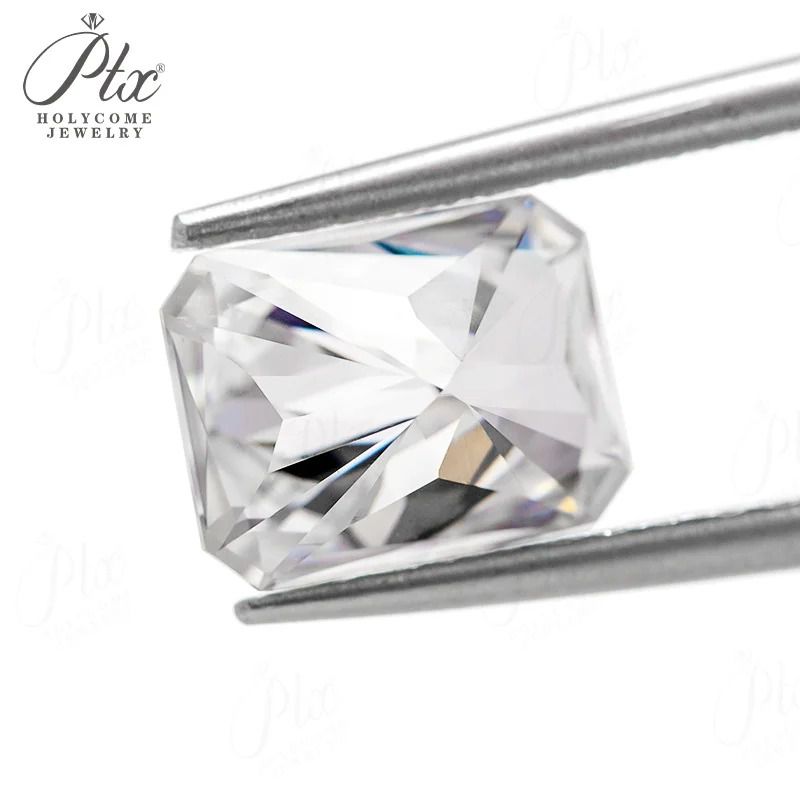
Walk into any wholesale moissanite showroom in Wuzhou and you will hear the same phrases: "D color VVS," "DEF white," "eye-clean VS." The grading language is borrowed almost wholesale from the diamond industry, but the meaning is not identical. For US independent jewelers buying loose moissanite, understanding exactly what D color and VVS clarity do — and do not — guarantee on a silicon carbide stone is the difference between a ringing counter and a returns conversation six months later.
Where moissanite grading comes from
Natural moissanite is extremely rare, and commercial loose moissanite sold today is laboratory-grown silicon carbide (SiC). Because it competes directly with mined and lab-grown diamonds, the industry adopted the GIA color and clarity scale so that customers could compare apples to apples. D is the top of the diamond color scale (colorless), VVS1 and VVS2 sit just below flawless on the clarity scale (very, very slightly included). On a moissanite stone these labels describe the body color under daylight and the visibility of internal inclusions under 10x loupe.
What "D color" actually means on moissanite
D color moissanite should appear colorless to the naked eye under daylight, with no obvious yellow, brown or gray face-up tint. But moissanite has a property diamonds do not: its strong birefringence and dispersion can create a faint double-refraction look at certain angles, especially under cool fluorescent office lighting. A true D grade means the body tone has been corrected to a white, neutral appearance that reads like a colorless diamond.
- D / E / F (colorless): Recommended for bridal solitaires, halo engagement rings, and any stone shown next to a customer's existing diamond jewelry.
- G / H / I (near-colorless): Acceptable for fashion rings, studs, and stones set in yellow or rose gold, where a faint warm undertone is invisible.
- Below J: We generally do not recommend stocking for US retail; the face-up tint becomes obvious and customers associate it with "cheap."
There is also a small but real body-tone conversation around "blue-white" vs "white" moissanite. Some older or lower-grade stock carries a subtle gray-blue cast that can look dull in natural light. When you specify D color in your purchase order, ask your supplier to confirm the body is white, not gray-blue, and request a daylight photo.
What "VVS clarity" means on moissanite
Clarity on lab-grown moissanite is generally very high because the crystal growth process produces far fewer natural inclusions than mined diamond. VVS1, VVS2, and even VS grades are all typically eye-clean — meaning no inclusion is visible to the naked eye from more than a foot away. The loupe-level distinction matters mostly for documentation and certificate matching, not for the end customer's experience.
- VVS1 / VVS2: Industry default for bridal stock; safe, certified, and resale-friendly.
- VS1 / VS2: Economical for fashion lines; still eye-clean under normal retail lighting.
- SI and below: Only consider if you have a specific, high-volume fashion customer who wants aggressive pricing.
One practical tip: because moissanite's facets are more numerous and its refractive index higher, inclusions are harder for the naked eye to find than in a diamond of the same clarity grade. That said, step-cut shapes (emerald, Asscher) show internal features much more clearly than round brilliants, so always step the clarity up one grade for emerald-cut stock.
Moissanite vs diamond: why the grading language is borrowed
It is worth pausing on why moissanite uses diamond's color and clarity scale at all. Moissanite is not graded by GIA under the same protocol as mined diamonds; the scale is a shared vocabulary adopted so that a customer standing in front of your case can compare a $400 moissanite solitaire against a $6,000 mined diamond and understand what "colorless" and "eye-clean" mean. That shared vocabulary is the product. If a customer cannot map what they see in your moissanite case to the diamond language they already know, the stone becomes harder to sell, not easier. This is why we strongly recommend buying stones that ship with the standard D/E/F and VVS/VS labels clearly printed on the certificate, rather than vague marketing terms like "premium white" or "top grade."
Color + clarity combinations that actually sell
After years of wholesale data, the stock combinations that move fastest in the US independent channel are:
- D color VVS round and oval: The bridal anchor. This is what most customers ask for by name.
- E color VVS emerald and pear: Step cuts and fancy shapes tolerate a near-colorless grade and give you margin headroom.
- G/H color VS princess and cushion: Fashion and right-hand rings; strong margin, fast turnover.
Common grading pitfalls for new buyers
The most common mistake new US buyers make is treating every "D VVS" parcel as if it were identical. Factory grading is not GIA grading. Two stones both labeled D VVS from two different factories can differ noticeably in body tone, edge sharpening, and facet alignment. Always buy a sample first, compare it under a daylight lamp against a reference diamond or known-good moissanite, and only then commit to a full parcel. Confirm that each stone ships with its matching GRA or equivalent certificate, with the laser inscription matching the girdle.
How to talk about grade with your retail customers
Because moissanite is a lab-grown simulant, most customers do not need — and would not understand — a detailed clarity lecture. Position the grade story this way: "This is a top-grade colorless moissanite, eye-clean to the naked eye, with a certificate that matches the stone." That is the language that closes sales without opening confusing technical doors. Stock D VVS for the bridal case, use near-colorless for fashion, and keep a small sample kit so you can show customers the difference.
Loupe-level checks your bench should perform
Even if every stone in a parcel is labeled D VVS, your bench should do a quick incoming inspection before the stone is set into a customer mounting. Three checks catch nearly every problem: (1) look through the table face-up under a daylight-balanced lamp to confirm the body tone is white, not gray-blue; (2) run a 10x loupe over the pavilion to confirm no chip, feather or laser inscription mismatch; (3) compare the stone's mm gauge against the certificate. A stone that fails any of these three checks should be returned to the supplier before it is set — once it is in a mounting, returns become much harder. Building this habit into your workflow protects you from the small percentage of parcels that slip through factory QC, and it is the single most reliable way to keep your bridal customers happy.
GemWSL ships D color VVS moissanite in every major shape and mm size, each with matching GRA documentation. Ask for our current grade stock sheet when you are ready to build your bridal inventory.